Q&A with the authors of The Sherlock Holmes & Lucy James Mystery Series


Die Again Mr. Holmes image


Q&A for MysteryThrillerWeek.com

Charles Veley & Anna Elliott, authors of The Sherlock Holmes & Lucy James Mystery Series


What’s it like crafting stories about the great Sherlock Holmes?

Pretty exhilarating, actually. We’re in a wonderful tradition, with a lot of brilliant company. And Holmes is so familiar to us both that it’s a joy imagining what he’d do when faced with a particular problem. At first we wondered how readers would respond to our bringing a daughter into Holmes’s life, but the overwhelming majority of reviews are enthusiastic supporters of the idea.  


Sherlock Holmes on spread image red


What was your creative process for writing Lucy James?

Anna had the idea of where she’d be the first time Holmes and Watson would see her – on the stage at the D’Oyly Carte opera, singing the lead in The Mikado. Watson described her there, and when she entered a few pages later, she took on a life of her own. She still does. We imagine the situations and Lucy takes it from there.


What kind of relationship do Sherlock and Lucy have and how do they complement each other?

They’re different, but equals. Sherlock has a deep and abiding respect for Lucy, and vice versa. Of course, she’s admired him ever since she read Watson’s accounts of his adventures when she was an American schoolgirl. In our stories, the two are not competing and the conflict is never the sort you would find in a ‘buddy’ movie. Our Sherlock and Lucy each go to different places and investigate different parts of the central problem. Then they exchange thoughts and draw their own conclusions. Generally, Holmes takes the role of cautious parent when advising Lucy — but he doesn’t always get his way. And they save each other’s life again and again. Towards the end of the first book there’s this exchange of dialogue, after Lucy saves Holmes in a gunfight and learns whose daughter she really is:

Holmes said quietly, “Lucy, I owe you my life.”

“Well, now I know I owe you my life,” said Lucy, her eyes shining. “So I guess we’re even.”

So, yes, different, but equals.


Sign BAKER STREET, Smoking Pipe, Magnifier On The OLD Map


How do you share in the writing process?

We start with the core situation of the story and exchange emails on that. Then we’ll send each other chapters of the opening scenes–Anna doing the Lucy chapters and me doing Watson’s. Soon we exchange more emails on where the story goes next, and then we’ll exchange blocks of chapters until we’re done. This all happens via email and Word documents, since we’re hours away from each other. Once in a while we’ll talk about it when we’re visiting or on the phone, but those times are generally devoted to family matters rather than our books.


Is Sherlock Holmes the greatest detective of all time?

Life Magazine says he is, in their 2016 issue titled “The Story Behind The World’s Greatest Detective.” Holmes is the most filmed character of all time, he has hundreds of fan clubs around the world, he has larger-than-life-size bronze statues erected to him in both London and St. Petersburg, and hundreds of new stories about him are published every year. Can any other detective say the same? Or even come close? I think the evidence is overwhelming. Though I must admit I’ve never seen Holmes’s picture on bubble gum cards ;-).


GREATEST - Glowing Neon Sign on stonework wall


What’s Lucy James’ view of her Father?

She understands that he needs his own space – just as she needs hers. Each of them has their own life to lead. Lucy has strong emotional relationships to people – her husband, to name but one person – and in some ways she feels regret that Holmes won’t have many of the satisfactions that come with the life of the heart. But she respects his long-ago choice to pursue his profession with such intensity. She has a unique understanding of Holmes based on what she’s learned about him from her mother. As we continue with the series, Anna and I are exploring the roots of Holmes’s passions for justice and crime-solving—we think that’s going to be a very compelling tale indeed.


What role does Watson play helping Lucy James and Holmes on cases?

Watson is the steadying force, the rock, the friend and companion for both Holmes and Lucy. Watson chronicles the parts of the story he sees, as he did in the original tales. He also pitches in with the investigative duties where needed, and even when he hasn’t been asked. Of course he’s always been a good man to have at your side when faced with danger–this holds true in our stories as well. Our Watson, however, shows his human side just a bit more than the canonical figure. He’s challenged when his relationship with Holmes is rocked by the entrance of Lucy into Holmes’s life, and since his wife Mary passed away, he’s feeling the need for relationships even more. Still, he has the satisfaction of always being a key player in the battles Sherlock and Lucy are waging with the evildoers.


If Sherlock and Lucy were alive today, do you think they could solve some challenging cold cases?

Most definitely! As our series opens, in fact, Lucy herself is working the 21-year-old cold case of her identity, and she and Holmes get that one solved by the end of the last chapter, even while stopping an assassination attempt that would have destroyed the Empire!  And that was without the aid of all the research tools we have today. So, the answer is definitely a resounding “Yes” I also think they’d take a good attitude toward our century if they found themselves here rather than in Victorian London. They’d both see the advantages to our global technology and wouldn’t spend a lot of time whining about trivia or how bored they are.


If you had to pick, who would you be: Watson, Lucy or Holmes?

It’s so tempting to pick Holmes, because who wouldn’t want to experience being that smart and energetic and independent, and also immortal?  Also, though he does have all the cares of the world (or at least the world of the current case) on his shoulders, and that’s a heavy responsibility to bear alone, he still has Watson and Lucy for support.


Charles Veley image Sherlock Holmes Mystery


Charles Veley has loved Sherlock Holmes since boyhood. During one year, he read the entire canon to his then-ten-year-old daughter at evening story time. He is extremely proud of her accomplishments as historical novelist Anna Elliott, and thrilled to be coauthor with her on the Sherlock and Lucy Mystery Series. Also a fan of Gilbert & Sullivan, he wrote “The Pirates of Finance,” a new musical in the G&S tradition that won an award at the New York Musical Theatre Festival in 2013. Other than “The Last Moriarty,” all the books on his Amazon Author Page were written when he was a full-time author during the late Seventies and early Eighties. He has retired from United Technologies Corporation, but still consults for the company’ regarding its large real estate development projects.


Anna Elliot Sherlock Holmes mysteries


A longtime devotee of historical fiction and Arthurian legend, Anna Elliott was expecting her first child when she woke up from a very vivid dream of telling her mother that she was going to write a book about Modred’s daughter, Isolde. She was very grateful to her daughter for being an excellent sleeper even as a newborn and allowing her the time to turn her dream into a finished book! She now lives in Princeton, New Jersey, with her husband and baby girl. Twilight of Avalon is her first published work.


www.annaelliottbooks.com

A Sherlock Holmes and Lucy James Mystery (9 book series)


Mystery Writer Samantha Goodwin speaks about The Murder At Macbeth


Sam Goodwin Low Resolution


Author Tempeste Blake interviews mystery writer Samantha Goodwin on her new release – Murder At Macbeth.


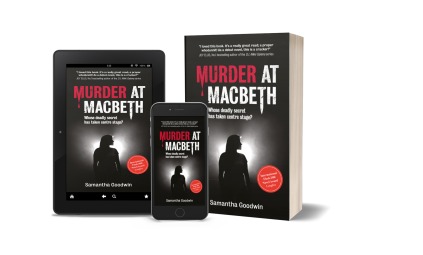
Murder at Macbeth image group of books


It’s MYSTERY THRILLER WEEK (www.mysterythrillerweek.com) and I’m doing a little happy dance. I’ve made great new friends at this event and found some fantastic reads to add to my library.

And speaking of new friends. Samantha Goodwin, author of Murder at Macbeth, and I recently sat down over tea and had a chat about … okay, really we talked via email and messenger, but I’m painting a picture so play along … we sat and drank tea and chatted about writing and books, especially those of the mystery variety, and here’s how some of the conversation went.


Hand writing the text: Q&A


T: Do you have any writing habits or superstitions?

S: I handwrite everything as I find my ideas flow better! It’s great because it means I can write anywhere, my favourite location is outside on those rare sunny English days. It is however, not the most time-efficient way of writing as then I have to spend time typing everything up as I go along and start editing!


T: Where did you get the inspiration for your story?

S: I was inspired by a newspaper article about a London West End actor who was accidentally stabbed live on stage. That got me thinking; what if that had been intentional? What a dramatic way to murder someone and believe you could get away with it.

I’ve always been fascinated by the superstitions surrounding Macbeth about it being cursed and the fact the play itself is about corruption and deception provided an interesting parallel to the murder mystery. Plus, I found the concept of interviewing suspects who are also actors really interesting; they could so easily be playing a part to hide the truth.


Idee als Glühbirne und Papierkugeln


T: How long did it take you to write your novel?

S: It took me one year to finish the complete first draft of my novel and then another year to complete the editing. Which considering I was working full time and pregnant while writing it, I was really pleased about! I carved out time to write every day but it usually ended up being only 30 minutes in the morning before work or 1 hour during my lunch break. At first it seemed completely impossible to write an entire book with such little time, but before long I found I could get into the swing of it and write pretty quickly. I actually found the balance of doing my editing and looking after a newborn much more difficult. I did a lot of one-handed typing while holding a sleeping baby!


T: I know asking about favorite characters can be like asking about a favorite child or pet, but . . . do you have a favorite character or one you’d love to bring back in another story?

S: I love both of the detective characters, I’ve deliberately set the novel up so it could work as the first in a series so it would be great to bring them both back in future stories. The astute Detective Inspector Finley Robson leads the murder investigation. Smart and resourceful, he has an uncanny ability for getting to the bottom of the toughest cases. However, he is also struggling to overcome his own troubled past and finds the unusual theatrical case resonates deeply with him. Detective Sergeant Nadia Zahra is his tenacious, no-nonsense partner who has risen quickly through the ranks to become one of the youngest detectives at the London Metropolitan police force. Fiercely loyal, she maintains a healthy disregard for bureaucracy and is a force to be reckoned with.


Follow the remainder of the interview on Tempeste Blake’s website: Author Interview: Debut Mystery Author Samantha Goodwin


Tempeste Blake

@samanthagoodwinauthor


Interview with Christine Carbo Author of the Glacier Park Mysteries


Christine Carbo image


A SHARP SOLITUDE – A GLACIER PARK MYSTERY

Interview for Benjamin Thomas


What’s your creative approach to writing a book?

I usually get my ideas from small things that spark my interest: an interesting article, a unique person, a story I’ve heard in the past that sticks with me, a line from a poem or a song…. If that thing of interest stays with me, I know I have the seed of an idea I’m willing sit with during the time it takes to write a novel. Once I have that idea, I will take some notes and brainstorm more ideas around the topic or character, but I’m not much of an outliner. I often simply end up diving in and writing as far as the headlights. Sometimes I’m at a loss for what should come next, get frustrated, and force myself to outline, but I rarely end up writing what I outline anyway, so it always comes out differently than I imagine it will. I also have no set writing schedule. I fit it in whenever it makes sense, sometimes in the morning, sometimes over the weekends, sometimes later in the day after my other job. I realize this is different from many other authors, but it has worked for me so far. I always think, someday I will create and stick to a writing schedule, but so far it hasn’t happened. Ha, I’m reminded of the saying: someday is no day.


Creativity


You write great characters in the Glacier Park mysteries. What’s the first thing you begin with? How do you develop them and bring out their flaws?

I often begin by thinking about a character’s childhood. So much of a character’s makeup depends on their upbringing: some important family dynamic (or even the lack of a family), a relationship with a parent, a traumatic event that may have happened. Our upbringings so often shape how we deal with circumstances that pop up later in life. Sometimes they prepare us well or sometimes our pasts leave us ill-equipped to deal with various situations and we end up making them so much worse than we want because of our own baggage. I find it interesting when a certain case or criminal situation that my detective or sleuth finds themselves embroiled in brings up unexpected emotions that have not been fully dealt with because of things that have occurred in their pasts.

For example, in my my first book, The Wild Inside, my main character is a lead detective – a Series 1811 – for the Department of the Interior who is called to the federal land of Glacier National Park to investigate a murder that occurs there. However, Glacier is the last place he wants to be because when he was young, something very traumatic occurred while he was camping there with his father. Right from the get-go, I know my character will be haunted by not only the place but by the crime he’s investigating. In my fourth book, A Sharp Solitude, my main character is a local, resident FBI agent in northwest Montana. She is also a single mom of a daughter she fiercely wants to protect and shield from having the type of childhood she had because when she was young, her father was not present and was even in prison for some time. She does not want her daughter to experience the lack of a father and makes sure she is able to spend plenty of time with her dad. However, he ends being a prime suspect in a local case, and my main character gets tangled up professionally because she is driven to protect her daughter. She gets involved in the case in spite of the professional conflict of interest. So, essentially, the things we throw at our characters can often resonate more deeply if they somehow brush up against past experiences of their lives.


Welcome to Glacier National Park


What’s the relationship like between Reeve Landon and FBI investigator Ali Paige?

Reeve is someone Ali actually respects. She admires his steady, persistent drive to go into the woods and do the work he does, which is part of the University of Montana’s canine detection program in which dogs are trained to help find the scat of certain wild animals for biologists to study. She does not view him as a deadbeat dad, like she saw her own father, yet, she does get irritated with him for putting his work first at times. Plus, in general, she does not understand how they can make a relationship work because, in fact, she sees him as being a little too much like herself. At one point, she thinks: “We both seemed to be followed by a certain darkness like a stray dog you can’t convince to go away. It was if we were always reminding each other that people never rid themselves of lonesomeness even in the company of a partner.” And of course, they both feel this way because of things that occurred in their lives when they were younger.


“We both seemed to be followed by a certain darkness like a stray dog you can’t convince to go away. It was if we were always reminding each other that people never rid themselves of lonesomeness even in the company of a partner.”


The settings are woven perfectly into your books. How important is it in your writing?

Setting is very important to me, but I like to point out that setting does not always have to be an entire area or town, or even nature. A strong setting can be a well-described trailer park, a busy, concrete-laden city, a popular bar, an old Victorian home, a cold cell in a jail, a small house not far from a refinery where the windows need to be shut when the wind is blowing in the wrong direction….

So, for me, the question is less about a particular setting, and more about the entire place that is the larger backdrop, or locale, for my stories which are made up of specific scenes in specific places. I don’t dwell on how to weave it in because I think that occurs naturally for the most part, but I do believe describing place is essential to creating good characters and stories because people are shaped by the places they reside, just as they are by their past experiences. And even past experiences took place somewhere, and that area will often inform how that experience played out and the character’s memories of what happened.

Because I reside in northwest Montana – where the landscape is such a huge part of our lives, where its grandness is obvious, I tend to weave geography and nature into my stories. I think many writers from the northwest and the west in general are well-aware of the area’s exceptionalism and therefore, incorporate it into their stories. I’m only about a half-hour drive from Glacier National Park, and at my house, where I usually write, I often see deer, elk, bear and sometimes a stray moose meander through my yard. Already this spring, I’ve seen a herd of up to seventy or eighty elk pass through about three times a week. It tends to inform our existence when every time we look out a window, we see something wild or dramatic, even if it’s simply the jutting mountains in the distance. When we drive to the store, we see fields with eagles perched on telephone poles looking for prey, reminding us that we’re never far from the wilderness. When I walk my dogs, I wouldn’t think of going into the woods without bear spray when the grizzlies are out of hibernation since I live close enough to fairly undeveloped areas, and even the developed ones have bears that meander through.

Also, Glacier brings millions of tourists to see its grandness, and I love Glacier, so it’s fun to set some of my stories in it or near it. I try not to preach in any of my novels, but I do keep in mind that nature is not something separate from us. And although Glacier is, in essence, an island of undeveloped, unmined, unlogged land – a place of unfettered beauty which is sometimes experienced by people like it’s an amusement park to be enjoyed briefly and then departed to return home where nature is not so obvious – I know that we are all a part of nature, even if we’re surrounded by concrete. I’m thrilled that we have conserved certain areas as we have, and I hope that people understand that these places should not simply be islands for enjoyment for a few weeks out of their lives and then left for their homes that might be viewed as less natural. No matter where we live, we are not separate from nature, and although concrete can create the illusion that we are, it’s important to understand how we are a part of it, even when we’re in the center of a city.

Because I carry these personal beliefs about the natural world, and because I’ve mainly written about characters living in northwest Montana, I tend to make characters that are acutely aware of their natural surroundings. I believe I would do this no matter where my book was taking place, even if not among the wilderness of my state. Over-description can definitely bore a reader, but a little attention to the clouds above and the trees on the sidewalk –even if they’re dying – and how characters notice these things or even the lack of them and how they treat them goes a long way to seat a story in geography, in place, and thereby create atmosphere. I do think that’s essential to a good story with deep characters.


Grunge state of Montana flag map


Have you been to a lot of sites you write about?

Yes, I’ve been to most of them, but every once in a while I make a place up: a landmark, a restaurant or a bar, a house, a campground….  In A Sharp Solitude, I have a scene about a shooting range near Tallahassee, Florida, and I made it up entirely because I have not been to a shooting range in Florida. Of course, even when making up a place, I still try to pay attention to the details that I imagine make that place unique.


In A Sharp Solitude, who is officially on the case of Anne Marie Johnson?

The county sheriff’s office has jurisdiction over the case since her body was found on county land, not far from Glacier National Park. She wasn’t found within the park; if she had been, the case would fall primarily under federal jurisdiction. Nor was she discovered in the city limits, so the police department is not involved either. In some instances, the county might ask for help from the city police department or from the resident FBI agents. However, I did not have my county characters corroborating with other agencies in A Sharp Solitude. The county runs the investigation on their own with two Flathead County deputies working for the detective division who are leading the investigation. The police department and the local FBI resident agents, however, would be well-aware of the crime and have access to its developments, which allowed me to have Ali, a resident agent, nudge up closely – too closely – to the investigation in spite of having a conflict of interest. When I was doing my research for the novel, I had called the lead detective from the county, and I asked her, would it be plausible for one of the local resident agents to just pop in to the county building while a detective from the county is interrogating a person of interest for a local crime without any reason other than to see how things are going? I had thought I was stretching things a little too far, but to my delight, she said that it happens all the time and that they all work closely together – that’s it’s not uncommon for the local resident agents to check in and see what’s going on and that they wouldn’t think twice of it. Sometimes, she said, the county asks for their opinion, their advice or for their help.


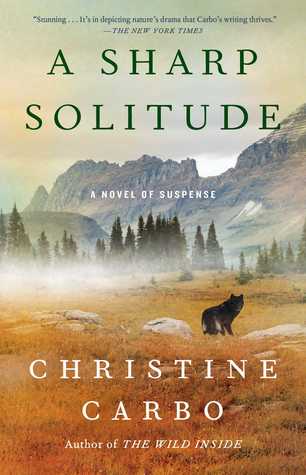
A Sharp Solitude image


What has helped your writing craft over the years?

Lots of reading, hanging around with other writers, going to workshops and learning to trust my own intuitions about my work. At times, especially when I first began writing, I have been insecure – as all writers tend to be at one point or another – and I have learned that insecurities can be helpful. So often, we think of the feelings of insecurity as awful and unwanted, but insecurities can actually provide fuel to get it right. They helped to keep me wanting to learn more, to never quit trying to do better, and to take advice.

On the other hand, I’m a little bull-headed too, which is also a useful trait in the world of writing. If you’re always taking advice from readers and critique groups, you can revise forever, especially if you can’t parse the good from the bad. It’s important to trust when you think you have it right and to stick to your guns when you do. Knowing when to listen to the critiques and when to shut them out can be a tricky balance. In other words, you need to know when it’s time to fully go with your story and trust in it, and that does take a certain amount of confidence. So, in other words, I’ve learned to use both my insecurities and my bull-headedness to my advantage, which has ultimately led me to be more confident in the process. But, it’s definitely a fluctuating process and some projects go more easily than others.


What are you working on next?

I am working on my fifth novel – one that has been a bit of a challenge for me (speaking of projects that go more easily than others). I have heard that sometimes a manuscript will resist us, no matter how much we love a subject, and this is my first experience with that. It doesn’t mean it shouldn’t be written. Quite the contrary – it means we’re onto something that is worth working harder on to get right. It just means we struggle a little more. In this novel, the main character has a very unusual job that not many people are aware of. She is a death-row mitigation specialist, which means she helps research, understand and interpret the dark case histories of criminals destined for death row to present recommendations to judges and jurors with the goal of mitigating their sentence. Only, she is currently taking a break from that job because she has had a crisis of conviction that has compelled her to retreat to a cabin in northwest Montana. A crime occurs in her neck of the woods that draws her back into that world which now haunts her, and she is forced to reckon with who she believes she is as a person.


Thanks so much, Benjamin, for asking such great questions!

All best, Christine


Christine Carbo image


Christine Carbo is the author of The Wild Inside, Mortal Fall, The Weight of Night, and A Sharp Solitude (all from Atria Books/Simon and Schuster) and a recipient of the Womens’ National Book Association Pinckley Prize, the Silver Falchion Award and the High Plains Book Award. After earning a pilot’s license, pursuing various adventures in Norway, and working a brief stint as a flight attendant, she got an MA in English and linguistics and taught college-level courses. She still teaches, in a vastly different realm, as the owner of a Pilates studio. A Florida native, she and her family live in Whitefish, Montana. Find out more at ChristineCarbo.com.


www.ChristineCarbo.com


Interview with Denise Domning Author of Servant of the Crown Mysteries


Denise Domning author image


Meet Denise Domning author of the Servant of Crown Mysteries  


mysteriousand magical image of woman's hand holding a gold crown over gothic black background. Medieval period concept.


How did you develop a love for medieval history?

I was ten when I decided I wanted to be an archeologist. I spent years studying hieroglyphics and became proficient enough to write a middle school essay using them, but my true love at the time was the Minoan culture. Then in the mid-80s I had a dream about the high Middle Ages in Europe. The light bulb went on and I started researching. I found myself drawn to one particular place and period – England in the years 1189 to 1199, or England under the absent King Richard. I’ve been researching that time period ever since although I’ve let my interests expand to his younger brother John. Suffice it to say I’m pretty focused.


You stated, The Final Toll was the hardest book you’ve ever written, but “I think I like it the best of all.” Can you tell us about this experience?

I blame the whole problem on my sleuth, Sir Faucon. You see, for the first time since he took the job of Warwickshire’s first Coronarius, he makes an error in judgment, one based on a common prejudice of his time. Neither he nor I knew he had this prejudice, mostly because it’s aimed at the people of his own class. Moreover, until this book, I’ve always been pretty certain who the murderer is from the moment I start writing. That’s not to say I don’t doubt. As each suspect presents him or herself and their story, I find myself saying, “Look! I was wrong. This is the one who did it!” In spite of my doubts, my first choice has ultimately been the right one.

I started The Final Toll with that same tenuous certainty, and it stayed with me even as I worked my way through the suspects. But when it came time for Faucon to make his accusation, I couldn’t get him to do it. No matter how I wrote the scene, he refused to agree with me. Even though I was certain I was right, I went back to the beginning and rewrote— not once or twice, but five times— trying to skew it so he would agree with my predetermined murderer. The clues refused to add up. Finally, the little piece I needed appeared, revealing that Faucon himself was the problem. Once he admitted that, et voila, as Faucon might say.
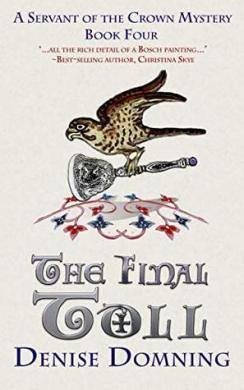


The Final toll image


What’s the historical context or background of this story?

This series of books is based on a snippet of history I discovered years ago. One of the most intriguing things about England in the Middle Ages is its ability to generate wealth for its king. Blame this on the Norman Conquest. Because of William and his Aunt Emma, all of England belongs to the English king who then grants pieces of it to those under him. That’s the perfect structure for a lucrative taxation system, something the Plantagenets did their best to exploit. In 1194, right after the English have already once emptied their coffers to pay King Richard’s ransom, Richard turns around and demands that his councillors find a way to wring even more silver out of his subjects, whom he detested and blamed for leaving him locked up in Germany too long.

Under Archbishop Hubert Walter, Richard’s councillors come up with a novel solution, or rather find an avenue that had yet to be fully exploited. It is the English king’s right to collect a fine—

as well as lives and limbs— from murderers, burglars, and rapists. However, collecting those fines depended on the royal justices appearing to hear the accusation and render a judgment when decades could pass between judicial visits to each shire. Life didn’t stand still in the interim. Appealers, the accused, or witnesses could disappear or die, or worse, accuser and accused could settle the matter privately between themselves, cutting the king and his fine right out of the picture.

Richard’s councillors introduce their solution at the Michaelmas court of 1194. First, they strip sheriffs of the right to investigate these capital crimes, mostly to prevent the common practice of the sheriff taking bribes from wrongdoers to look the other way. Then they pronounce that each shire must elect three honest knights, each knight having an income of more than twenty pounds a year, to become the new keepers of the pleas. Finally, the councillors make the most important change of all and require that these knights employ a clerk at their own expense. For the first time every plea for royal justice will now be written down. This notation must include not only the crime, the value of the estate of the wrongdoer, and the verdict of the inquest jury, but the names of witnesses and the jury members. The edict not only includes the capital crimes of murders, rapes, burglaries where the stolen item is worth more than a shilling, but “any foul act,” such as treason or outlawry, where property or goods might be forfeit to the king. Never again will the royal treasury be cheated because appealer and accused settled “out of court.”

And why did Hubert Walter and his colleagues limit the choice of knights to only those with a substantial income of their own? The brilliance of this new position of Coronarius, or servant of the crown, is that it’s unpaid. Now if that isn’t efficient government, I don’t know what is.

That’s where my sleuth, Sir Faucon de Ramis, finds himself in October of 1194, as the first coroner for Warwickshire. Unfortunately, or fortunately as Faucon soon finds, there is very little direction as to how to do this job. He swiftly realizes he needs to determine to his own satisfaction who committed the murder so he’s certain he’s assessing the right estate.


Knight Medieval kneeling image with sword


How important is setting in historical fiction versus the setting in other genres?

I can’t say that setting is any more or less important to historical fiction than any other genre as every genre has its conventions. What makes or breaks a novel is how deft an author is at conveying the expected milieu. In that, historical fiction can be unforgiving. Readers who love this genre already know their history. Beware the author who doesn’t check her facts for she will suffer the slings and arrows of critics who remind her that sycamores are an American tree and potatoes come from the New World. For the record, neither of those were my errors but I have heard from readers protesting facts that in other genres would be deemed unworthy of comment.

In historical fiction it’s not enough to be comfortable with the details of your chosen time period. You also have to get that information from your brain through your fingers and into the book in a way that doesn’t stop the flow. For me that requires writing out all the details I think I’ll need for a particular scene, say a meal in a merchant’s house. How many tables are there and how are they set? What’s on the floor? Where are the windows, if there are windows? Is there a newfangled chimney or is there a central hearth? What colors/designs are painted on the walls? What

furniture might there be besides the tables? Is there crockery? How does it smell? What sounds fill the air from nearby homes or their own workshops? Are they close enough to hear the bells from the nearest church? Are there regraters outside in the street selling goods? Is the neighboring merchant shouting out to passers-by about his wares?

Once I’ve answered those questions, I go back and tighten, tighten, tighten, eliminating this, shortening that, until there are just enough details to describe the scene without slowing the action. This is very hard to do for someone who writes history textbooks disguised as novels to educate unsuspecting readers. I want to share every cool fact I’ve learned. To protect my readers, I employ this mantra: “If I love it, take it out.”



Medieval castle middle ages image


What are some of the customs of Warwickshire?

That’s a pretty broad question, so I’m assuming you mean the customs of Faucon’s time period. It’s surprisingly difficult to research local customs, celebrations and rituals. It’s even harder to verify that a particular ritual was practiced the same way in the 12 Century as it was when th someone finally wrote a description of it in the 14 Century. Fortunately for me, Faucon is new th to Warwickshire although his small inheritance, which comes to him through his mother, is in the forest of Arden. He isn’t aware of any customs although perhaps he’ll eventually find his way to the Rugby area on Martinmas, 1195 for the collection of Wroth Silver. Although he’ll be in near Atherstone in his next book, the onset of the Atherstone ball game is still five years distant.

With that said, there are plenty of general customs and traditions for me to employ. Life in this time period revolves around two calendars which often intersect. The first is the yearly progression of Catholic celebrations, festivals, and masses. The second is the seasonality of farming. For instance, Lady Day or Candlemas on February 2 is also the day to celebrate the nd beginning of the farming year with plow races. As for Edmund, he’s more likely to note the date on his scribblings as “third day after Martinmas in the third year of the reign of our holy Father, Celestine III.”


Warwickshire, vintage stamp on paper background


How is it different than a typical city of today?

For three days after the awful events of 9/11 an awesome quiet broken only by birdsong ruled our skies. That’s when I realized I’d never once experienced the world without the sound track of engine noise. It was a pivotal moment for me in my understanding of what it was like to live in the late 12 Century. th

Medieval people live within sight and sound of nature. In rural communities the days begin with everyone’s roosters crowing along with the honk of domesticated geese, the quack of ducks, and the cooing of doves from their dove cote. A truly riotous avian chorus erupts from every tree, thicket and bush. There’s the complex song of a lark, the shrill military chatter of a kingfisher from the nearby stream and the mundane chatter of the swallows nesting under the eaves of barns and sheds. In the spring and fall, the skies fill with vast flocks of migrating wild ducks, geese and swans, so many that the almost non-stop honking must have been deafening. In those areas kept

wild for the pleasure of noblemen, stags trumpet to attract mates, the rare wolf howls and boar offer up blood-curdling grunts.

In the barnyards, sheep and goats bleat, cows low (or moo, depending on which word you prefer), and pigs grunt, all of them demanding attention. Rats and mice skitter and rustle in the thatch along with the occasional hedgehog. Everyone coughs, because even though the smoke is supposed to wind its way out of the hole in the cottage roof, smoke is everywhere. And everything–absolutely everything–in the cottage smells like smoke.

The ring of blacksmith’s hammer is rhythmic and even as he brings it down again and again on the thick piece of metal he’s turning into a tool. The bellows that keep his fire hot enough to soften iron gust and whoosh. At the grist mill, the miller snaps the goad over the back of his ox and the big creature begins to walk an endless circle. The grinding stone rumbles, turning steadily, the sound loud enough that the miller has to raise his voice to speak to customers; the knife sharpener’s wheel rumbles; the potter’s wheel rumbles as he shapes clay into new pots. The carpenter’s saws rasp through lengths of wood. The hammers of the wheelwright and cooper thud dully as they work narrow strips of metal onto their wheels and barrels.

And everyone sings. At the fuller’s cottage newly woven cloth is being fulled— the process of tightening the weave so the fabric doesn’t unravel— to the cadence of a specific set of songs. More songs ring out from the fields where the men swing their scythes. They use the rhythm to keep their movements in sync and prevent accidental injury. Down at the stream, the women sing as they rub their clothing clean while their youngest children chatter and play.

It isn’t as pleasant for those who live in the burgeoning towns of this era. Walled cities mean limited space, so dwellings are crammed close to each other. Beware the second storey window for the household maid may use it to empty the master’s chamberpot onto the street. There’s no privacy either inside or outside of the home. Every marital spat, every man practicing his sackbut, every family celebrating some milestone can be overheard, whether by folks on the streets or the family next door. If things get a little rowdy, the watch will be called and the offenders asked to hold it down

This may be a city but the denizens keep all the same animals as their rural cousins. Roosters crow, cats yowl, dogs bark, pigs grunt, cows low and sweetly cooing doves rain you-know-what down from above. Although these urban householders might also hear the tumble of water from their windows— every town and city has a reliable water source— chances are that the water carries the stench of human and animal wastes, including pollution from local industries such as slaughterhouses and dyers. Oh yes, humans were hard at creating toxic waste even a thousand years ago.

12 Century merchants and priests depend on knowing the time and that means a church bell. In th London at this time there are thirteen monastic houses as well as one hundred parish churches. Imagine the cacophony, all the bells ringing every three hours during the day, and of course for every funeral or event that might need to be announced to the public. Here, new technology— water power— is changing the way work is done. Water now turns the wheels that turn the gears

that drop the hammers onto metal or cloth. The never-ending thumping and clanging is so overwhelming that town councils are passing ordinances limiting when these mills can run.

Very few homes in the towns and cities are just a place to live. Instead, most are also the homeowner’s business establishment, with his shop located on the ground floor. Every day our merchant throws open the shutters of his shop and pitches his goods to all passersby at a shout. Regraters— think of them as Medieval mobile food trucks— walk the streets with their handcarts or wheelbarrows filled with something to sell, be that fresh fruit, day-old bread, or cheese. As they walk, they shout for folk to come buy their excellent wares. Priests and monks ride past on braying donkeys.

Where there is trade, there’s wagon traffic moving goods from one place to another. Bellowing oxen, their owners shouting and snapping goads, drag wagons along narrow, mucky lanes. Mounted merchants lead long trains of pack animals from city to city along what we would consider nothing more than an animal track.

Just as they do today, day laborers stand on corners and call out in the hopes of being hired. At night they’ll be replaced by the women who sell themselves to earn their daily bread. And then there are the ale houses, the pubs of their day. Every alewife has her own recipe and some serve food as well as drink. The folk who frequent these establishments are generally travelers or people without the ability to cook their own meals. For the folk who makes homes in the corners of sheds or in warehouses, the alehouse is often their only chance to enjoy the warmth of a fire and of community, so the singing commences.

That was the long answer to your question. The short answer is the only differences are the combustion engine and the lack of television.


Medieval town image


If I sat down with Sir Faucon de Ramis for tea what would be my first impression?

You would find yourself sitting across from a dark-haired man of medium height who wears his skin easily, the way men who have often come face-to-face with death do. There’s a native intelligence in Faucon’s dark eyes. He could well have become a successful Churchman, as is the usual fate for second sons of his class, except that his elder brother suffered a head injury that left him with concussion-related spontaneous rages. Faucon’s father immediately pulled his younger son from his monastery school and turned him into a knight and heir-in-waiting, something Faucon’s elder brother resents deeply. Once knighted, Faucon joined King Richard on Crusade, mostly to escape his family’s difficult and guilt-ridden dynamics. As often happens, leaving the safety of home for unfamiliar circumstances has caused Faucon to mature beyond his years, and given him the ability to feel comfortable anywhere. These traits are what causes his great-uncle, Bishop William of Hereford, to endow Faucon with enough property that he qualifies to become a Coronarius.


Tea being poured image


Who is Brother Edmund and what is his job description?

Brother Edmund is the scribe or clerk whose job it is to write down all the particulars of the crimes Sir Faucon investigates, including the assessment of the wrongdoer’s estate. We don’t know much about him, except that he is in his middle years, is from the Norman-French speaking higher classes, and is well educated in English law. That’s hardly the usual CV for a mere scribe, and sure enough, Edmund didn’t start out as a clerk. He has been a Benedictine monk for most of his life. Unfortunately, Edmund suffers from a surfeit of rigidity in his personality and this character flaw has caused him to be banished from more than one abbey. He describes himself to Faucon as an honest man who will only speak as his heart directs. And so he does, never recognizing that he wields his “truth” as ably as Faucon swings his sword. As much trouble as this creates for Faucon, he swiftly realizes this demoted monk repays honesty with loyalty and has a surprisingly fearless heart.


What’s next  for you

What’s next is book five in this series, entitled (so far) “Caught Red-handed.” I’ve once again come across an unusual factoid, this time about the walking dead of the Middle Ages. It was just too interesting to pass up, especially when I found evidence of it in Warwickshire.



mediaeval knights on horseback


Amazon | Goodreads | Twitter | Facebook


Interview with Alice K. Boatwright Author of the Ellie Kent Mysteries


Alice K Boatwright image


Alice K. Boatwright

Alice K. Boatwright is the author of the award-winning Ellie Kent mysteries. In the first book, UNDER AN ENGLISH HEAVEN, life brings the skeptical American Ellie Kent to an English village as the vicar’s new wife; but death keeps her guessing how long she’ll be there. Winner of the 2016 Mystery & Mayhem Grand Prize for best mystery, UNDER AN ENGLISH HEAVEN has attracted an enthusiastic following.

The series continues with WHAT CHILD IS THIS? It’s now Christmas in Little Beecham . . . a season to celebrate with caroling, mistletoe, and mince pies. Ellie Kent is looking forward to her first English village Christmas, but a missing Oxford student and an abandoned baby soon draw her away from the fireside into danger.


Under an English Heaven image


What child is this image


Interview


Who is Ellie Kent and where did she come from?

Ellie Kent is a divorced American professor of English literature in her mid-30s who falls in love with Graham Kent, a widowed English vicar in his mid-40s, marries him, and moves from San Francisco to his home in a Cotswold village. That is her biography, but, as to where the idea for her came from, I would have to say that, like all of my characters, she began as a mixture of me and not-me characteristics and slowly revealed herself as an independent being through the stories about her.


What is your method of character creation?

I don’t have any one method. Characters come to me in a variety of ways – for example, I wrote a story about a girl I saw on BART (the Bay Area subway) who had her hair dyed like a rainbow. Another was inspired by the idea of writing about someone who thought Marilyn Monroe should star in the movie of her life. Often I give my characters qualities that are the opposite of mine, which I think is a way of telling myself “This is not me.” For example, my women characters are almost always taller than I am and have dark hair. Wish fulfillment! They can also do all sorts of things that I would never attempt to do. . . such as solve a murder mystery. When I first conceived of Ellie, I was visiting England, but I lived in San Francisco, taught part-time, and longed to be able to move to England.


Create Ideas Aspiration Solution Inspiration Concept


How do you go from character creation to telling her story?

By the time I began writing UNDER AN ENGLISH HEAVEN, my husband (who is neither English nor a vicar) and I had left the US and were living in an English village. I knew from the start that I wanted to write about my love for England, its culture and traditions – as well as all of the changes Ellie would be faced with as an ex-pat and newlywed in a strange country. These issues became the backdrop for the mystery and an integral part of the book. I also knew that I wanted to write about the period from Halloween to Remembrance Day and plot elements, such as that Ellie would be accused of murder and would try to solve the mystery to clear her name. I knew the identity of the dead man from the first . . . but all of the details of his story took several drafts to become clear. I never outline. I prefer to let a story to evolve like a photograph that develops gradually and comes into focus over time.


What are the elements of good storytelling?

The bottom line is that the story offers believable characters striving against the odds to achieve what they need or think they want – and succeeding or not.


Storytelling Puzzle Audience Emotion Engagement 3d Illustration


How did Ellie and Graham meet?

They met by accident at the home of Ellie’s parents in Berkeley, California. Her father is a retired professor who taught for a year at Oxford during Graham’s time as a student there. Years later, when Graham is on a sabbatical in the Bay Area, he visits his former professor – and meets Ellie. Over several months, they become friends and lovers, and then decide to marry when it is time for him to return to England.  The first book takes place less than two months after their marriage.


What is the Cotswold village of Little Beecham like?

Little Beecham is a fictional, but typical, Cotswold village of honey-colored limestone cottages and shops, originally built to support a now-ruined manor house. The high street boasts a village store/post office, butcher shop, pub, antique shop, used bookstore, and library. It is book-ended by the 800-year-old St. Martin and All Angels Church at one end and the village school at the other, with a village hall just on the outskirts. Surrounded by woods and fields, it is picturesque without being a tourist attraction. It is located in Oxfordshire about 25 miles from Oxford.


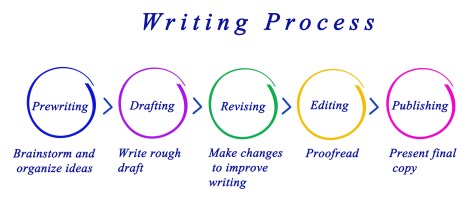
Describe your editing process and the importance of rewriting.

For me, writing is rewriting.  I do my first draft very fast – like a sketch covering the whole canvas. Then I carefully build up the picture over about seven main drafts. Along the way I make notes, write character studies, draw maps, create timelines, consult experts, do research. As I get closer to the end, I print out the whole manuscript and read it aloud. Very close to the end, I share the manuscript with readers whose perspective I value and an editor. I also do my own final copyedit.


Diagram of Writing Process.


What do you like about having an amateur sleuth?

I love the traditional English mysteries with amateur sleuths, especially Miss Marple, Miss Silver, Harriet Vane, Agatha Raisin, Mary Stewart’s heroines, and others. Amateurs have to be brave, imaginative, and willing to improvise. They have no structure to rely on, no job description, no license.  Although I enjoy reading many types of mysteries, I have never been interested in writing any other kind.


What do you enjoy most about writing mysteries?

I like the fact that the traditional plot structure provides a scaffold on which to build the story, but you can vary the other elements as you wish. Creating the puzzle at the core of the story is a very interesting challenge because, as author, you know too much to experience it as the reader will. Finally, it is satisfying to write books where justice is served and good triumphs (at least to some extent). I think we all need that message these days.


woman hands


What are the most challenging aspects of writing?

The most challenging aspect of writing is sticking with your project through all the phases of uncertainty until it is the best book you can write. . . then following it through the further uncertainties of publication and public response. In writing, persistence is at least as important as talent.


What’s next for you?

I am working on the third Ellie Kent mystery, another book that has a mystery element but is not a murder mystery, and several short stories.


Alice K Boatwright image


Alice is also the author of the award-winning COLLATERAL DAMAGE, three linked stories about the Vietnam War told from the perspective of those who fought, those who resisted, and the family and friends caught in the crossfire.

She has taught writing at UC Berkeley Extension, the University of New Hampshire, and the American School of Paris. After 10 years of living in England and France, she now makes her home in the Pacific Northwest.


Website | Newsletter | Twitter | Facebook


Historical Mystery with Alan Bradley’s Flavia De Luce

Interview with Alan Bradley


Describe the historical background during which your story takes place.

The Flavia de Luce novels are set about five years after the end of the Second World War. England is still impoverished from the conflict, and social recovery has scarcely begun. Rationing is still in effect and times are tough. Old England is gone, and everything now seems shambles and decay. Only by clinging to ancient traditions do the people find a sense of comfort and security.


A lot of your stories take place in the English village of Bishop’s Lacey. What were such places like during the 1950’s?

Before the building of the motorways, and the rise of the motor-car, English towns and villages were much more isolated than today. Transportation was by railway. There was a profusion of local institutions and government, each providing services to a relatively small area. Many people had never traveled far from where they were born, although that was beginning to change. The war had brought an influx of servicemen from the U.S. and what remained of the British Empire. Strangers were viewed with suspicion. Some things never change.



Recessed Country Map Britain


What did you learn about Flavia De Luce while writing this story?

Flavia never ceases to amaze me, especially her frightening grasp of the underside of chemistry. I am always as surprised as any reader at the things she says and does. In “The Golden Tresses of the Dead”, I began to discover Flavia’s underlying compassion. I began to suspect that she might, in the end, come to love a few people as much as she loves corpses. Well…almost.


I love all of the titles of your books. Describe how you came to name “The Golden Tresses of the Dead.”

The title is taken from Shakespeare’s Sonnet 68, and concerns a certain ghastly and despicable practice which was once fairly common among those who will stop at nothing in their lust for money. Does it still exist? I hope not, although you can never be sure about anything where money is concerned.


SHAKESPEARE - close-up of grungy vintage typeset word on metal backdrop


What do you enjoy most about writing historical mysteries?

The research is always great fun. England in the 1950’s has always been of special interest to me, and ferreting out forgotten customs and folklore is like a paid holiday. It isn’t so much a case of finding ideas as weeding out the vast number that present themselves. Each book centres upon a particular long-lost English custom or peculiarity, ranging from sociopathic stamp-collecting to peculiar religious sects, and from Gypsy caravans to the exhumation of saints.


What can you tell us about Ophelia and her wedding?

Feely has come to the altar at last, after a protracted on-again-off-again courtship with former Luftwaffe pilot, Dieter, who has elected to remain in England after being shot down and kept captive as a prisoner of war – and all because of his love of the Bronte sisters! Their courtship has been a war in itself, with Feely as fierce as any Field Marshal. Now, just when peace seems about to break out, something nasty is found in the wedding cake.


wedding funny cake


What’s the relationship like between her and Flavia?

It has been mostly a life of revenge and re-revenge. Feely is as vain a creature as ever fogged mirror with her self-admiring breath. Flavia fancies poisons. The outcome is inevitable.


What role does Dogger play in this one?

Arthur Wellesley Dogger, who served with Flavia’s father, Colonel de Luce in the Far East, suffers from what would nowadays be diagnosed as PTSD. Because of his fragility, Dogger has worked at different times as gardener, manservant, and general all-round handyman. But much about the man himself remains shadowy. In “The Golden Tresses of the Dead” Flavia and Dogger found their own detective agency: Arthur Dogger and Associates – Discreet Investigations. Their first official case involves rogue missionaries, quack remedies and, of course, that abominable crime to which I have referred above. All typical, of course, of a sleepy country village.


I recently had the pleasure of listening to an interview you had with Jayne Entwistle on Audiophile. What was it like speaking with Jayne for the first time?

It was astounding to find how similar our experiences had been in my writing the books and her recording them for the audiobook versions. Jayne has won awards for her portrayal of Flavia, and with good reason: her ability to bring to life a whole cast of characters is a special gift. The interview was conducted by an interviewer in New York, with Jayne in Los Angeles, me in a tiny studio on an island in the middle of the Irish Sea. It was like getting Mercury and Pluto together for a good old chinwag and an abundance of laughs. What we had in common, of course, was Flavia de Luce, who seems to have approved. At least, she hasn’t poisoned either of us….yet.


****

Behind the Mic with Audiophile Magazine: Interview with Alan Bradley & Jayne Entwistle


Originally appears on AudioFile Magazine Feb. 15, 2019. Duration 30 min. 


Alan Bradley image


About Alan Bradley

Alan Bradley received the Crime Writers’ Association Debut Dagger Award for The Sweetness at the Bottom of the Pie, his first novel, which went on to win the Agatha Award, the Barry Award, the Dilys Award, the Arthur Ellis Award, the Macavity Award and the Spotted Owl Award. He is the author of many short stories, children’s stories, newspaper columns, and the memoir The Shoebox Bible. He co-authored Ms. Holmes of Baker Street with the late William A.S. Sarjeant. Bradley lives in Malta with his wife and two calculating cats. His seventh Flavia de Luce mystery, “As Chimney Sweepers Come to Dust” will be published in the US and Canada on January 6, 2015, and in the UK on April 23.


www.alanbradleyauthor.com


The Elements of a Bestselling Thriller: Top Tips for Authors


Bestseller neon sign on brick wall background.


The Elements of a Bestselling Thriller: Top Tips for Authors

by Adam Durnham


When it comes to conjuring ideas for a thriller or mystery, authors should create perspectives that are relevant to current readers with a special attention to market trends. What are the possible elements of a bestselling thriller? Read to know more.

After reading a gripping mystery or thriller, do you find yourself thinking about how interesting it was? If you’re an author, there are elements to bestselling thrillers that can help your readers stay on the edges of their seats.

In order to do this, authors may want to strike a balance between the foundational elements of their work and current trends in thrillers and mysteries. Here are some top tips for authors who are planning to create pieces in these special genres.


Pick the type of thriller or mystery genre that you want to create

Thriller or mystery novels are broad categories on their own. It is important to know who your target readers are. Knowing your target audiences will help you determine the literary subgenre that you will use. Some thriller subgenres include:


  • Psychological thrillers: These thrillers include themes relating to psychological or mental health conditions. The protagonist or the perpetrators in such stories might have mental health issues.
  • Mystery thrillers: These thrillers feature mysteries that revolve around a crime, accident, or another incident. The protagonists in these works find and analyze clues throughout the stories.
  • Science fiction thrillers: These popular thrillers incorporate science fiction topics. Authors may be particularly creative with this subgenre, which may include futuristic themes such as aliens, monsters, human cloning, and entirely new worlds.


Developing clear ideas about your subgenres gives you a laser-sharp focus on the elements that you want to place in your story. The focus helps readers feel that your characters, settings, plot twists, and other crucial parts of your work are thematic and fit together cohesively.


Choose relevant themes

Theme is quite different from your subgenre. It unifies your story and gives something for your readers to think about as they progress through your story. This is helpful if you want to create a thriller or mystery novel, since you want to provide puzzle pieces that the readers can think about as they approach the end.


Consider using thriller or mystery story themes that people find relatable. They can involve problems such as mental health, addiction rehab, crime, or social injustices. These themes can bring value to your readers, especially if your readers advocate for such topics. Your book has a better chance at reaching the best-seller lists if many of your readers have firsthand experience with or knowledge of your themes.


Successful writers pay attention to what is happening in the larger culture. When topics about mental health, addictions, crime, or social problems appear in the news, books and movies associated with these relevant themes also appear.


Plot your story before beginning to write

Before starting your first chapter, consider creating an outline of your thriller or mystery to develop your plot. Outlines are important for many types of work, but they are especially crucial for thrillers and mysteries because those genres include large amounts of action. Creating a well-plotted story can help you avoid unnecessary fluff and irrelevant elements in your writing.


Your plot should include a buildup of conflict, and your characters’ goals and motivations should be consistent with your themes. Thrillers or mysteries can start at the middle of the action to create a thrilling atmosphere that you can heighten for effect.


Experiment with multiple points of view

One sign of a great author is his or her flexibility in presenting the points of view of various characters. Some bestselling thrillers and novels shift between the viewpoints of the protagonists and the villains in the stories instead of presenting the story entirely in the third person perspective.


Shifting between multiple points of view depends on your theme and other elements of your story. But multiple viewpoints can greatly benefit mystery and psychological thrillers. They can showcase the depth of the story and portray the intrinsic motivations, thoughts, and actions of the characters.


Create interesting plot twists

To develop an interesting plot twist, you need to get inside the minds of readers. One element of bestselling thrillers or mystery novels is that many plot twists can appear quite predictable at the beginnings of stories yet profound and surprising at the ends of the same pieces.

You can create these puzzle pieces to appear one way at the beginning and middle of your stories while creating a sense of jeopardy and conflict. Such story construction encourages readers to exercise their common sense and typical thought processes as they proceed through the plot.

When they encounter your story’s plot twist, readers may be surprised and pleased when your writing reveals your actual story. This shift is what makes the story gripping and exciting for readers. Well-written plot twists are one of your greatest tools as an author of mysteries or thrillers.


Ready, set, write!

If you keep in mind these elements of writing a bestselling novel, you can stay on top of your game. Great authors create solid foundations for their stories, incorporate creativity, and understand trends that matter to readers.


Golden Best Seller Award Over Black Paper Background


Managing the Ensemble Cast of Characters by Saralyn Richard

ENSEMBLE - Glowing Neon Sign on stonework wall


Managing the Ensemble Cast of Characters


by Saralyn Richard

When I decided to write a mystery novel situated around a weekend birthday celebration at a country mansion (Murder in the One Percent ©2018 Black Opal Books), I wasn’t fully aware of how challenging it would be to populate the party with a slew of guests and keep the novel moving for readers. To start with, I wanted to have seven couples on the guest list, plus a single, for a total of fifteen characters. Some would be the hosts, one would be the murder victim, one or more would be the killer(s), and others would be the suspects. Fifteen seemed like a fine number until I started to write the first few chapters.


dinner party toast image


For one thing, the party guests, like most in real life, were quite similar. Most of them had been to college together, and most of them had careers in the same field of endeavor. They were all members of the wealthy one percent, so they all wore expensive clothes and jewelry, enjoyed multiple residences, and indulged in luxurious hobbies. It was fun to pull back the curtain on their lives, but I soon realized a few things:


  • The characters were too much alike.
  • Readers would have a hard time remembering who was who.
  • Readers would have a hard time identifying with any of the characters.
  • There wasn’t enough contrast among the characters to make for interesting dialogue, narration, and description.


Once I understood the challenges of managing the ensemble cast of characters, I cut one couple from the book, taking the number at the party to thirteen. What a perfect number for a party that started on a Friday the 13th, a party where someone would be killed.

Next, I created a character bible for each partygoer. It wasn’t enough to document the physical traits of each one. I wanted to give everyone a particular way of talking, speaking, moving. So if a character flipped her hair behind her shoulder or rubbed the material of her pants between her thumb and forefinger when nervous, the reader would know exactly which character that was.

While all of the characters were among the ultra-rich, I gave them different experiences with money, and different attitudes toward it, as well. Some inherited it, some earned it, some had it and lost it, and some married into it. Some were haughty, while others were down-to-earth.

Each of the characters has had identifiable past experiences with the victim, some unpleasant enough to serve as a potential motive for killing him. As everyone comes together to a weekend retreat at a remote country mansion, the reader is presented with a “locked room mystery.” The killer has to be one of the party guests.

Once the murder occurs, the detective and other characters provide plenty of contrast, but by then, the readers have already formed impressions of the ensemble of one-percenters. All they have to do then is buckle up and enjoy the ride.


Galveston Author Saralyn Richard


Award-winning mystery and children’s book author, Saralyn Richard, is a writer, who teaches on the side. Her children’s picture book, Naughty Nana, has reached thousands of children worldwide. Murder in the One Percent, semi-finalist in the Chanticleer CLUE awards for best suspense/thriller, pulls back the curtain on the privileged and powerful rich. Set on a gentleman’s farm in Pennsylvania and in the tony areas of New York, the book shows what happens when someone comes to a party with murder in his heart and poison in his pocket. Look for the sequel, A Palette for Love and Murder, at the end of this year. Saralyn has published stories, articles, and poems in a variety of collections and magazines, and she edited the anthology, Burn Survivors’ Journey. A member of International Thriller Writers and Mystery Writers of America, Saralyn teaches creative writing and a literature class. Her website is www.saralynrichard.com


Interview with Clara Benson Author of the Angela Marchmont Mysteries

Clara Benson image


Please welcome historical mystery author Clara Benson!

Clara Benson is the author of the Angela Marchmont Mysteries and Freddy Pilkington-Soames Adventures – traditional English mysteries in authentic style set in the 1920s and 30s. One day she would like to drink cocktails and solve mysteries in a sequinned dress and evening gloves. In the meantime she lives in the north of England with her family and doesn’t do any of those things.


Interview 


  1.    What was your path to becoming a writer?

–          I started out as a translator (Italian to English, since you asked), but I always thought I would write a book at some point, and eventually I decided that if I was going to do it I’d better get on with it! It took four years to write my first, in between moving, having kids, house renovations, etc, and I’m surprised I ever got it finished, to be honest. But once it was done and published and people were buying it, that spurred me on to write more. Now I can’t imagine doing anything else.


  1.    What do you enjoy most about historical mysteries?

I love the innocence of them! We’ve all read all the mysteries these days, so it’s difficult to truly surprise the reader, and nowadays the solution is far more likely to hang on a microscopic piece of forensic evidence than on anything else. But I love the fact that in historical mysteries the detective can sweep in, point at someone and say, “The clock said 6.05 instead of 6.08, and your train ticket was dated Wednesday not Tuesday, which proves you are the murderer! Inspector, arrest this man!” And the murderer always snarls and says, “Damn you, you’re as cunning as the devil!” And they arrest him and take him away and it’s all wrapped up in a nice neat bow.


Bow yellow blue box image gift


  1.    Why do you write English mysteries set in the 1920’s and 30’s?

–          Because that’s what I like to read. I’m a huge fan of Golden Age mystery writers – Agatha Christie, Dorothy L Sayers, Josephine Tey and so on, and I wanted to try and write something similar to the stories they wrote that I love so much.


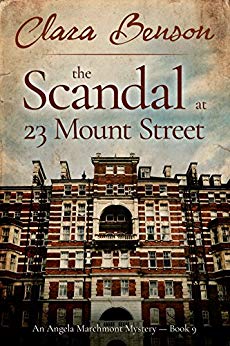
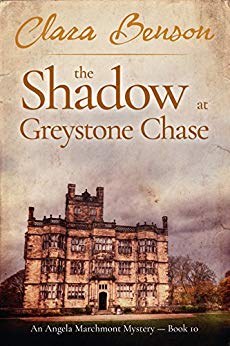
  1.    Who is Angela Marchmont and why choose her as a protagonist?

–          Angela Marchmont is something of an enigma to start with, and we don’t know much about her except that she’s a wealthy, fashionable and independent woman in her late thirties who’s a bit secretive about her past. As the series continues, we find out more about her, and by the final two books there are a few revelations as all her secrets come out! I didn’t exactly choose her – she kind of developed herself along the way. She was meant to be older and more eccentric, but she had her own ideas, and emerged as a younger and much more charming character than I expected!


The Scandal at 23 Mount street image


The Shadow at Greystone Chase image


  1.    What makes her a good detective?

–          She’s curious by nature, and has a questioning mind. She’s smart, obviously, but also very cool, logical and level-headed. She’s quite good at cutting through the red herrings and getting to the solution.


  1.    Tell us about the Freddy Pilkington-Soames series.

–          Freddy was an occasional sidekick of Angela’s, and he was such a strong character I thought he deserved his own series. He’s younger than Angela – only in his early twenties – and he works (I use the word loosely) as a reporter for an early tabloid newspaper, the Clarion. He’s hedonistic, chaotic, very full of himself, and prone to getting into awkward situations. In his attempts to solve a mystery he can often be found dangling off a rooftop, getting into a fight, or kissing someone else’s girlfriend – not always through any fault of his own.


A Conspiracy in Clerkenwell image


A Case of Duplicity in Dorset image


  1.    What was your experience transitioning from Angela Marchmont mysteries to writing Freddy Pilkington-Soames?

–          It’s quite different writing Freddy, as he’s a lot more active than Angela – partly because of his job – so I have to think of a lot of places for him to go, rather than just weekend country house parties. In addition, he’s a bit of an unruly sort, so I have to think up difficult situations for him to get out of. He’s a bit of a smart alec too, so I spend a lot of time rewriting his dialogue to make it wittier!


  1.    How do you conduct research for your books?

–          This is one of the best parts of writing! Although I’m not one for packing a lot of historical detail into my books, I do like to get things right, so I’ve read quite a few history books about the period, and I also make fairly heavy use of the Times Digital Archive (through my library) and the British Newspaper Archive (paid subscription). I’m a big stickler for using the correct language of the period, and for that I use the online version of the Oxford English Dictionary (also via the library), which shows when words were first used. Then of course there’s Google and Wikipedia…


get the facts


  1.    What’s the historical background of A Case of Duplicity in Dorset?

–          None, I’m afraid! It all came out of my own head, although I did get some inspiration for Belsingham from some grand stately homes near where I live, most notably Nostell Priory and Harewood House.


  1.  Who are your favorite mystery authors?

–          As I said, I’m a big fan of Golden Age authors, but I’ve read all kinds of mystery writers, from Ruth Rendell and PD James to Sue Grafton, Patricia Cornwell and Kathy Reichs. Unfortunately, I don’t get to read many new mysteries these days, as I find it interferes with the writing, so I find myself going back to the old favourites time and time again.


Opened book with flying letters


  1.  If you had to write in another genre which would it be?

–          I do occasionally branch out into romantic suspense, and I have a few ideas for future books in that genre which I will write when they pass a law to add more hours to the day…


  1.  What’s next for you?

–          I had a bit of a go-slow year last year, as I felt I needed to recharge after several years of frantic writing activity, but I’m well and truly back in the saddle now – possibly too much, as I’m busy trying to write two books at once! One is a historical novel set during World War 2, which is much more serious and sombre in tone than my usual style, and the other is Book 5 in the Freddy series, entitled A Case of Suicide in St. James’s, in which Freddy investigates the apparent suicide of a young man at a society ball. This one is turning out to be fun, and I hope to get it finished very soon!


Thanks Clara! 

www.clarabenson.com | Goodreads | Amazon


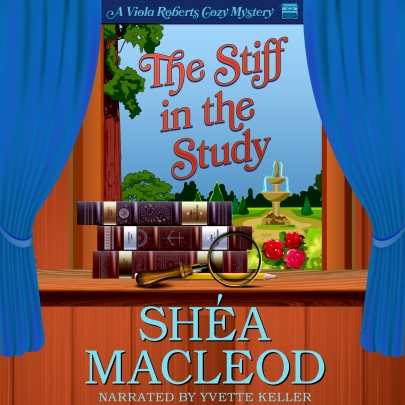
Audiobook Blog Tour: The Stiff in the Study by Shea Macleod


Viola Roberts Banner


Stiff in the study image Viola Roberts book 2


About Audiobook #2


Author: Shéa MacLeod

Narrator: Yvette Keller

Length: 4 hours 20 minutes

Publisher: Shéa MacLeod⎮2017

Genre: Cozy Mystery

Series: The Viola Roberts Cozy Mysteries, Book 2

Release date: May 17, 2017


Synopsis: Viola Roberts is at it again! The sleepy seaside town of Astoria, Oregon is the last place you’d expect to find a dead body. That is until the director of the local museum turns up dead in the study and Viola’s friend, Portia, is accused of the crime. Viola ignores her looming deadline and bout of writer’s block and sets out with her best friend, Cheryl, to solve the murder. From starting riots at local dive bars to breaking into crime scenes, Viola will stop at nothing to prove Portia innocent even if it means putting herself in the cross-hairs of the killer.


Buy Links for Audiobook #2

Buy on Audible


Mystery Letterpress


I’ve come to love the hilarious adventures of Viola Roberts and her sidekick Cheryl. Listening to this audiobook reminded me of the Golden Girls, or Laverne and Shirley from the old days of television. They feed off one another, complement each other. Narrator Yvette Keller plays the part perfectly. Her voice characterizations are on the money and color each personality just enough draw you into the story.


stars 4 image with hand.jpeg


Shea Macleod image


About the Author: Shéa MacLeod


Shéa MacLeod writes urban fantasy post-apocalyptic sci-fi paranormal romances with a twist of steampunk.  Mostly because she can’t make up her mind which genre she likes best so she decided to write them all.

After six years living in an Edwardian town house in London just a stone’s throw from the local cemetery, Shéa headed back to her hometown of Portland, Oregon. She plans to live out her days eating mushroom pizza, drinking too many caramel lattes, exploring exotic locales, and avoiding spiders.

Shéa is the author of the Viola Roberts Cozy Mysteries and the bestselling Lady Rample Mysteries.


WebsiteTwitterFacebookInstagram


www.rewindphotography.com Santa Barbara Wedding Photographer
http://www.rewindphotography.com Santa Barbara Wedding Photographer


About the Narrator: Yvette Keller


Yvette Keller’s first job as a narrator was reading aloud to keep her little brother out of trouble. Her favorite party trick is reading words upside down. Little kids need to see the pictures. Yvette lives in her beloved home town of Santa Barbara, using a lifetime of vocal stamina in her home studio. She produces technical VO industrials for Mesa Steps Consulting clients in addition to audiobooks. A lifetime of reading and speaking has proven one thing: Yvette loves stories. She is thrilled to be making books accessible and engaging through her narration work.


WebsiteTwitterFacebook