Interview with Robert Bailey Author of the McMurtrie & Drake Legal Thriller series


Robert Bailey image


Meet Robert Bailey author of the McMurtrie & Drake Legal Thriller series
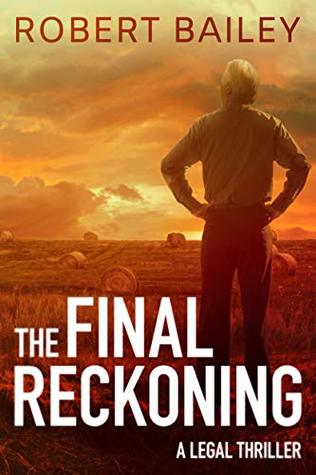


The Final Reckoning image


His last challenge: live long enough to save the lives of those he loves.

Cold-blooded killer JimBone Wheeler blames Tom McMurtrie for putting him on death row. He once vowed that he’d bring “a reckoning” on Tom and everyone the southern lawyer holds dear. When Wheeler escapes from prison, he aims to fulfill his promise. Victim by victim, he’s getting closer to his ultimate target. But for Tom, who’s dying of cancer, the role of savior and protector is a struggle that is becoming more desperate by the hour.

As the body count mounts, Tom, his partner, Rick Drake, and his best friend, Bocephus Haynes, brace for a confrontation like nothing they have ever faced before. This battle will be waged not in a courthouse but on the streets and fields of north Alabama. With all those he loves at risk, Tom must save his family, his friends, and his legacy from a killer whose hunger for retribution knows no bounds.

Now, as time ticks down and fate and vengeance close in, who will survive Wheeler’s final reckoning?


Amazon | Goodreads


Interview Key Shows Interviewing Interviews Or Interviewer


What was your creative process when you wrote Tom McMurtrie?

ANSWER:  I was daydreaming in a law school class one day about what would happen if my professor actually had to try a case.  It was very much a smart aleck idea at the time, but it stuck with me. Soon, I was imagining this legendary professor who would return to the courtroom with a former student and I had the situation that would form the basis for The Professor.


What type of law did he teach in book one, The Professor?

ANSWER:  Evidence


What’s the relationship like between Tom McMurtrie and Rick Drake?

ANSWER:  Tom was Rick’s Evidence professor and trial team coach when Rick was in law school.  During a trial team competition, Rick and Tom got into an altercation, and the publicity from this incident cost Rick a job with a prestigious law firm and forced him to hang a shingle and become a solo practitioner.  In The Professor, Tom refers a longtime friend, whose family has been killed in a tragic trucking collision in Henshaw, Alabama, to Rick for representation.  He makes the referral because Rick is from Henshaw but also in the hopes that the case would give Rick’s career a boost. The two men’s estranged relationship eventually resolves and they team up to take on the trucking company by the end of the story.  For the remaining three books, they are partners in the law firm of McMurtrie & Drake.


Legal Sign Design With Scales Of Justice Symbol.


Who is Bocephus Haynes and how did  he meet Tom?

ANSWER:  Bo is also a former student of Tom’s as well as being Tom’s best friend.  Bo is an African-American attorney practicing in Pulaski, Tennessee. Bo met Tom after an injury derailed his football career during college.  After being mentored by Tom, Bo decided to go to law school and went on to become one of the finest trial lawyers in the state of Tennessee.


In The Last Trial, what’s the story behind Tom and his old nemesis Jack Willistone?

ANSWER:  Jack Willistone was the ruthless trucking tycoon from The Professor, who is arrested at the end of the story.  Jack makes a brief cameo in book two, Between Black and White, and is murdered at the beginning of The Last Trial.  The person accused of the crime, Wilma Newton, is represented by Tom in the ensuing murder trial after Wilma’s oldest daughter begs Tom to take the case.


The Last Trial image


In The Final Reckoning, who is Jimbone Wheeler?

ANSWER:  JimBone Wheeler is a death row inmate who blames his imprisonment on Tom.  At the beginning of the story, JimBone escapes from incarceration with the help of a rogue nurse.


Death row prison image dark


What are his motivations in this story?

ANSWER:  To bring a reckoning on Tom and everyone Tom holds dear.


What kind of cancer is Tom McMurtrie dealing with in The Final Reckoning?

ANSWER:  State IV lung cancer


What is he fighting for in this story?

ANSWER:  Tom is literally fighting for his life and the lives of those he loves, as he tries to stop JImBone Wheeler from obtaining his reckoning.


Robert Bailey image


Robert Bailey was born in Huntsville, Alabama, the son of a builder and a schoolteacher. From the time he could walk, he’s loved stories, especially those about Coach Paul “Bear” Bryant and his beloved Alabama Crimson Tide football team.

Robert obtained a Bachelor of Arts in History from Davidson College in North Carolina. Law School at the University of Alabama followed, where Robert made Law Review, competed on the school’s trial team and managed to watch every home football game.

For the past thirteen years, he’s been a civil defense trial lawyer in his hometown of Huntsville. He’s married to the incomparable Dixie Bailey and they have two boys and a little girl.

When Robert’s not writing, practicing law or being a parent, he enjoys playing golf, watching Alabama football and coaching his sons’ little league baseball teams.


Goodreads | Amazon | Twitter



Inspiration by Andrew Cairns

Andrew Cairns image


Black Magic Inspiration

The continent of Africa abounds with stories of black magic and witchcraft. Unlike in Western culture where witch stories have mostly been shelved along with fairy-stories or history, in Africa such tales remain an integral part of the various cultures and belief-systems.

I found my inspiration for writing The Witch’s List Trilogy through travels in Africa, meeting people who still have strong beliefs in witchcraft and black magic, and listening to some of their incredible stories. I also try to draw from some of my own experiences and use my imagination to think about how things might have worked out differently, if I’d made different decisions at certain points in my life.

I first encountered black magic on a visit to the Ivory Coast, where I was introduced to the notion of a mysterious list maintained by a witch of obscure identity: if your name is on the list, so they believe, it means you’re going to die. As a sceptic European, I was rather surprised how seriously people took this witch’s list, even Ivorians like my wife at the time, who’d lived most of her life in France. When someone fell ill in the village people would whisper, “Perhaps she’s on the witch’s list?” Fingers were pointed at this person or that, suspected of being in league with the witch, of adding someone’s name to the list or even of being the witch. If someone received some unexpected money or success, they might be accused of having obtained such good fortune by being in league with the witch.

So that was my main inspiration for writing the first novel, and when I began writing it, I thought it would be interesting to integrate a coming-of-age tale about a naive young Scot who gets drawn into this web of black magic. Ideas for writing the trilogy came to me: to use three phases in the main character’s life as parts in the trilogy – adolescence / the beginnings of adulthood; adulthood / marriage; and children / growing old. I also wanted to look at some of the traditions and belief-systems in different geographical regions: West Africa in the first part, North Africa in the second part, and as for the third part, well… I don’t want to give too much away yet! I’m also attempting to show how the character’s conscience and morals evolve over time, basing the three different parts on the concept of nafs in Islam, which translates as the self or the ego. The three main stages of the nafs are: the inciting nafs, where lower basic instincts dominate; the self-accusing nafs, where the conscience is awaked and some sense of right and wrong develops; and finally the nafs at peace where the soul becomes tranquil and one’s faith and resolve to do good are resolute.

Other sources of inspiration include authors such as Tahir Shah, Iain Banks, Paul Auster, Douglas Kennedy, and William Boyd; not forgetting – since the trilogy falls loosely in the horror / supernatural genre – horror greats like H. P. Lovecraft, Stephen King, Dean R. Koontz, and Dan Simmons.

I would also like to recommend a new author I discovered recently, Eowyn Ivey. Her two novels are based in 19th century Alaska. The first one, The Snow Child, is based on a Russian folk tale about a girl made out of snow coming alive. The second is a story of exploration and adventure in the unforgiving climate of Alaska, with myths and supernatural elements an integral part of the tale.


Andrew Cairns image


Andrew Cairns is the author of the Witch’s List, a witchcraft themed novel released in June, 2016. The novel follows sceptic Sandy Beech, who marries an exotic Ivorian woman, and drawn into her world, finds himself subject to mystefying and dangerous black magic. He is forced to confront his deepest beliefs as he attempts to extricate himself from these events before they kill him.

His second novel, One More Arabian Night: Book II in the Witch’s List trilogy, takes Sandy on a new adventure to Morocco, where he hopes to wed the beautiful Hurriya, a medical student whom he met in Paris. He must come to grips with the local customs and superstitions: miraculous water, djinns, polygamy… and once again witchcraft!


Interview with Alice K. Boatwright Author of the Ellie Kent Mysteries


Alice K Boatwright image


Alice K. Boatwright

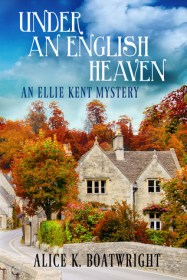
Alice K. Boatwright is the author of the award-winning Ellie Kent mysteries. In the first book, UNDER AN ENGLISH HEAVEN, life brings the skeptical American Ellie Kent to an English village as the vicar’s new wife; but death keeps her guessing how long she’ll be there. Winner of the 2016 Mystery & Mayhem Grand Prize for best mystery, UNDER AN ENGLISH HEAVEN has attracted an enthusiastic following.

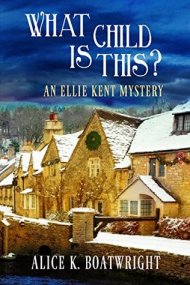
The series continues with WHAT CHILD IS THIS? It’s now Christmas in Little Beecham . . . a season to celebrate with caroling, mistletoe, and mince pies. Ellie Kent is looking forward to her first English village Christmas, but a missing Oxford student and an abandoned baby soon draw her away from the fireside into danger.


Under an English Heaven image


What child is this image


Interview


Who is Ellie Kent and where did she come from?

Ellie Kent is a divorced American professor of English literature in her mid-30s who falls in love with Graham Kent, a widowed English vicar in his mid-40s, marries him, and moves from San Francisco to his home in a Cotswold village. That is her biography, but, as to where the idea for her came from, I would have to say that, like all of my characters, she began as a mixture of me and not-me characteristics and slowly revealed herself as an independent being through the stories about her.


What is your method of character creation?

I don’t have any one method. Characters come to me in a variety of ways – for example, I wrote a story about a girl I saw on BART (the Bay Area subway) who had her hair dyed like a rainbow. Another was inspired by the idea of writing about someone who thought Marilyn Monroe should star in the movie of her life. Often I give my characters qualities that are the opposite of mine, which I think is a way of telling myself “This is not me.” For example, my women characters are almost always taller than I am and have dark hair. Wish fulfillment! They can also do all sorts of things that I would never attempt to do. . . such as solve a murder mystery. When I first conceived of Ellie, I was visiting England, but I lived in San Francisco, taught part-time, and longed to be able to move to England.


Create Ideas Aspiration Solution Inspiration Concept


How do you go from character creation to telling her story?

By the time I began writing UNDER AN ENGLISH HEAVEN, my husband (who is neither English nor a vicar) and I had left the US and were living in an English village. I knew from the start that I wanted to write about my love for England, its culture and traditions – as well as all of the changes Ellie would be faced with as an ex-pat and newlywed in a strange country. These issues became the backdrop for the mystery and an integral part of the book. I also knew that I wanted to write about the period from Halloween to Remembrance Day and plot elements, such as that Ellie would be accused of murder and would try to solve the mystery to clear her name. I knew the identity of the dead man from the first . . . but all of the details of his story took several drafts to become clear. I never outline. I prefer to let a story to evolve like a photograph that develops gradually and comes into focus over time.


What are the elements of good storytelling?

The bottom line is that the story offers believable characters striving against the odds to achieve what they need or think they want – and succeeding or not.


Storytelling Puzzle Audience Emotion Engagement 3d Illustration


How did Ellie and Graham meet?

They met by accident at the home of Ellie’s parents in Berkeley, California. Her father is a retired professor who taught for a year at Oxford during Graham’s time as a student there. Years later, when Graham is on a sabbatical in the Bay Area, he visits his former professor – and meets Ellie. Over several months, they become friends and lovers, and then decide to marry when it is time for him to return to England.  The first book takes place less than two months after their marriage.


What is the Cotswold village of Little Beecham like?

Little Beecham is a fictional, but typical, Cotswold village of honey-colored limestone cottages and shops, originally built to support a now-ruined manor house. The high street boasts a village store/post office, butcher shop, pub, antique shop, used bookstore, and library. It is book-ended by the 800-year-old St. Martin and All Angels Church at one end and the village school at the other, with a village hall just on the outskirts. Surrounded by woods and fields, it is picturesque without being a tourist attraction. It is located in Oxfordshire about 25 miles from Oxford.


Describe your editing process and the importance of rewriting.

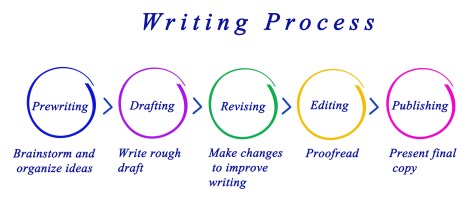
For me, writing is rewriting.  I do my first draft very fast – like a sketch covering the whole canvas. Then I carefully build up the picture over about seven main drafts. Along the way I make notes, write character studies, draw maps, create timelines, consult experts, do research. As I get closer to the end, I print out the whole manuscript and read it aloud. Very close to the end, I share the manuscript with readers whose perspective I value and an editor. I also do my own final copyedit.


Diagram of Writing Process.


What do you like about having an amateur sleuth?

I love the traditional English mysteries with amateur sleuths, especially Miss Marple, Miss Silver, Harriet Vane, Agatha Raisin, Mary Stewart’s heroines, and others. Amateurs have to be brave, imaginative, and willing to improvise. They have no structure to rely on, no job description, no license.  Although I enjoy reading many types of mysteries, I have never been interested in writing any other kind.


What do you enjoy most about writing mysteries?

I like the fact that the traditional plot structure provides a scaffold on which to build the story, but you can vary the other elements as you wish. Creating the puzzle at the core of the story is a very interesting challenge because, as author, you know too much to experience it as the reader will. Finally, it is satisfying to write books where justice is served and good triumphs (at least to some extent). I think we all need that message these days.


woman hands


What are the most challenging aspects of writing?

The most challenging aspect of writing is sticking with your project through all the phases of uncertainty until it is the best book you can write. . . then following it through the further uncertainties of publication and public response. In writing, persistence is at least as important as talent.


What’s next for you?

I am working on the third Ellie Kent mystery, another book that has a mystery element but is not a murder mystery, and several short stories.


Alice K Boatwright image


Alice is also the author of the award-winning COLLATERAL DAMAGE, three linked stories about the Vietnam War told from the perspective of those who fought, those who resisted, and the family and friends caught in the crossfire.

She has taught writing at UC Berkeley Extension, the University of New Hampshire, and the American School of Paris. After 10 years of living in England and France, she now makes her home in the Pacific Northwest.


Website | Newsletter | Twitter | Facebook


Interview with M.R. Mackenzie Author of the Anna Scavolini Thrillers


M.R. Mackenzie image


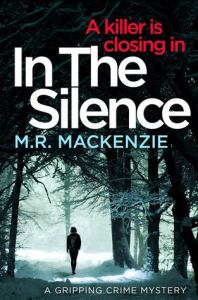
M. R. Mackenzie was born and lives in Glasgow, Scotland. He studied at Glasgow University and has a PhD in Film Studies. In 2016, he contributed a chapter on the Italian giallo film to Cult Cinema: An Arrow Video Companion.

In addition to writing, he works as an independent Blu-ray/DVD producer and has overseen releases of films by a number of acclaimed directors, among them Dario Argento, Joe Dante and Seijun Suzuki.

His debut novel, In the Silence, reached #2 in Amazon UK’s Scottish crime fiction bestsellers chart.


In The Silence image


Goodreads | Amazon


Interview 


Why did you decide to get a PhD in Film studies?

If I’m being completely honest, a major factor was that, at the time, I was in my early twenties and had very little idea as to what I hoped to do with my life. I’d just completed a Masters in Film Studies, which I’d enjoyed, and felt I had certain things to say about an obscure body of films – the Italian “giallo” thrillers of the early 1970s – which no one else was saying. One of my lecturers, who later became my thesis supervisor, encouraged me to do a PhD, which I took as a vote of confidence and duly submitted my application. In doing so, I was able to avoid the big bad world for another five and a half years, while at the same time exploring, in considerable depth, a body of films I really like. The end result was a 90,000-word doorstop that people tell me has enhanced their understanding of and enjoyment of giallo films… though I did come out the other end knowing I didn’t want to spend another minute in academia!


Take 1 One First Attempt Try Scene Movie Clapper Board 3d Illust


What was it like writing your first book?

Strangely enough, a lot like writing my PhD thesis, both in terms of overall word count and the sheer amount of time I spent on it! In the beginning, I wasn’t really sure what I was doing or if I was even capable of writing a novel, but I persevered and, over the course of several years, kept coming back to the manuscript, chipping away at it, refining it, adding layers to it… If I was doing it again today, it wouldn’t take me anything like as long – indeed, I wrote the first draft of the manuscript I recently finished in little more than two months – but at the time it was an essential learning process for me as I was effectively teaching myself how to write a novel from scratch, so there was a lot of trial and error involved.


How does your writing process differ between screenplay and manuscript?

It’s funny you should ask, because In the Silence, my first novel, actually started life as a screenplay. I wrote it very quickly: it took me somewhere between two and three weeks to go from the initial idea to a finished (albeit seriously rough) first draft – so I suppose you could say the biggest difference is time! I tend to find that there’s not actually a whole lot that separates the two mediums when it comes to the early planning stages. With both, I write copious notes and spend a long time figuring out the structure, the twists and turns, where the various act breaks occur, and then only start the actual process of drafting once I have a very thorough outline from which to work. A crucial difference, though, and one that I’ve learned to really appreciate as I’ve left scripts behind in favour of novels, is that, when you’re writing prose, you’ve got an opportunity to really get inside your characters’ heads. You’re party to their inner thoughts and emotions in a way that you’re simply not with a film. When you’re writing a script, you have to convey everything through action and dialogue, whereas, with a novel, you’re free to draw on a much broader and in my view richer toolset.


Safety Equipment Near Toolbox With Various Worktools


What did you experience writing about criminology lecturer Anna?

Writing Anna is definitely an interesting experience. In many respects, we have a lot in common, while in others we’re polar opposites – not least the fact that I’m a 6 ft 3 man while she’s a 5 ft 2 woman! She’s someone who tends to have very definite opinions about things – again, some of which I agree with, while with others I disagree with her completely. In real life, I’m not sure how well we’d get on – though I suspect I’d probably just play it safe and agree with everything she said – but I do admire her determination and tenacity… even if it sometimes gets her into trouble. Over the course of In the Silence, I take her to some very dark places indeed, and I can tell you for a fact that I don’t half as much resilience as her.


What do you enjoy writing about crime fiction?

It’s a really good question and one I’m not sure I can adequately explain. I find myself drawn to crime and horror, both on the page and on the screen, both as a reader/viewer and as a writer. I suspect there’s something about the vicarious thrill of exploring our darkest fears from a position of safety – a bit like going skydiving or on a rollercoaster. But I also think that, more than pretty much any other type of “genre novel”, crime fiction tells us something about society. All the best crime novels, in my opinion, comment on or reveal some sort of truth about the world today, whether it’s something their authors put there deliberately or something that’s seeped into the bones of the story without its creator being conscious of it. Also, I really love a good mystery and putting all the clues together, whether I’m the one coming up with them or just the one trying to figure them all out.


Hands placing last piece of a Puzzle


Tell about Zoe Callahan in your next book, Cruel Summer.

Zoe was a secondary character in In the Silence, and for Cruel Summer, I elevated her to the position of central protagonist. I designed her to be the polar opposite of her best friend Anna. Where Anna is studious and a bookworm, Zoe is a party girl. Where Anna has very definite opinions about the way the world is and how it should be, Zoe doesn’t really have what you would call an ideology. Her emotions are very intense, but her response to any given situation is always governed by how it affects her or the people she cares about in the immediate sense as opposed to having a highly developed moral or philosophical set of beliefs. That makes her a lot of fun to write, because her responses are always very raw and visceral. She has a keen sense of right and wrong, and when she perceives an injustice as having taken place, she’s incapable of sitting on her hands and doing nothing. But because she’s naïve and impulsive, she tends not to think through the consequences of her actions, so her attempts to make things better quickly end up having precisely the opposite effect…


Who is Dominic Ryland and what motivates him?

Ryland is a mysterious figure, and intentionally so. He’s a charismatic but previously largely unknown politician who is suddenly thrust into the spotlight when certain shadowy figures, who are pulling the strings behind the scenes, pressure him into running for leadership of his party. We fairly quickly discover that he’s not a nice man at all, though I’ve deliberately kept his motivations, and the nature of the hold his “handlers” have over him, vague. If you want to find out where he really comes from and what motivates him to do what he does, you’ll have to read the book!


Does Cruel Summer have any thematic elements?

The main theme of Cruel Summer is justice – more specifically, exploring the limitations of the judicial process and both the rights and wrongs and the implications of taking matters into one’s own hands when the official system lets you down. Smashing the system, standing up to power, dispensing your own idea of justice – all these things are incredibly appealing, but as Zoe learns to her cost, all actions have consequences, and other people may end up paying the price for your follies…


Cruel Summer Image


Zoe Callahan is having the summer from hell… and it’s about to get a whole lot worse.

She’s stuck in a dead-end job, her relationship is going nowhere, and the memory of the Kelvingrove Park Murders three years ago continues to cast a long shadow over every aspect of her life.

When a prostitute is brutally assaulted by Dominic Ryland, a rising political star with a suspiciously spotless personal reputation, Zoe leaps at the chance to distract herself with a noble cause, and sets out on a one-woman crusade to bring Ryland to justice.

But in doing so, she quickly finds herself on the wrong side of some very dangerous people – people who have reputations to protect and who would think nothing of silencing Zoe by any means necessary.

An explosive thriller set against the backdrop of a sweltering heatwave, Cruel Summer is the sequel to M.R. Mackenzie’s critically acclaimed In the Silence and the second instalment in the Kelvingrove Park Trilogy.


Available May 28 pre-order now: Cruel Summer


M.R. Mackenzie image


M. R. Mackenzie was born and lives in Glasgow, Scotland. He studied at Glasgow University and has a PhD in Film Studies. In 2016, he contributed a chapter on the Italian giallo film to Cult Cinema: An Arrow Video Companion.

In addition to writing, he works as an independent Blu-ray/DVD producer and has overseen releases of films by a number of acclaimed directors, among them Dario Argento, Joe Dante and Seijun Suzuki.

His debut novel, In the Silence, reached #2 in Amazon UK’s Scottish crime fiction bestsellers chart.


M.R. Mackenzie


Why I write Psychological Thrillers by A.J. Waines


AJ Waines black and white image


AJ Waines writes Psychological Thrillers with *nearly half-a-million* copies sold worldwide. She’s a #1 Bestselling Author: GIRL ON A TRAIN topped the full UK and Australian Kindle Charts in 2015 & 2016. She’s also the author of Psychological thrillers Don’t You Dare, and Inside The Whispers. 


Don't-you-Dare Medium


No Longer Safe AJ Waines image


Why I write Psychological Thrillers

By AJ Waines


As a child, I devoured the Famous Five mysteries by Enid Blyton and was later drawn to crime thrillers, such as A Simple Plan by Scott Smith and The Day of the Jackal by Frederick Forsyth. Ever since they became recognised as a distinct category, however, I’ve been captivated by psychological thrillers, loving writers such as Minette Walters and Nicci French, from the 1990’s onwards. At the time, I was in awe of all writers and the idea of actually putting together a psychological thriller myself was completely beyond me!

Before I first had a go at writing fiction in 2008, I was a psychotherapist for 15 years. As well as seeing clients with mainstream issues such as low self-esteem, depression and relationship issues, I was privileged to work with ex-convicts from high-security institutions. I found this work fascinating and aside from giving me ideas for novels, it gave me considerable insight into the disturbed and criminal mind.

So, should I try to write murder mysteries or psychological thrillers..? Which would I choose? In the end I didn’t. I put the two genres together.

In my first attempt at a novel, The Evil Beneath, I wanted to create a story that had a distinct mystery on the surface and a deeper psychological thriller lurking underneath. To create dissonance between what the reader ‘knows’ and what the lead character hasn’t yet worked out. I like to find ways to mislead the reader and to create jeopardy from the ‘inside-out’, rather than from the ‘outside-in’. By this I mean that the characters are exposed to danger on a mental level – mind-games and deception – rather than (or as well as!) a physical one.

I’ve written nine psych thrillers to date, with another in the pipeline, and my plots usually centre around the  hidden unreliability or instability of individuals in the story. My protagonists often face a tortuous situation: a missing child, a death made to look like suicide, a stalker, a simple but deadly mistake, for instance. In Don’t you Dare, for example, the story starts with a mother misunderstanding a situation involving her daughter and killing someone. This kind of mystery allows the reader to get right inside the minds of key players. It encourages them to try to anticipate how characters might handle certain dilemmas and tempts the reader towards trying to figure out what their true motives are. Not just ‘who dunnit’– but ‘why’ and ‘how dunnit’! It also invites readers to consider: what on earth would I do if I was faced with this situation..?

Most of all, I like the idea of dramatic events happening to ordinary people. A dark and deadly puzzle involving clues where hidden dangers come to light. I love twists and turns and that big OMG moment at the end, of course – that turns everything on its head! In my novel, No Longer Safe, for instance, nothing is as it seems… Many readers told me that when they got to the end of the book, they were so gob-smacked, they had to go back to the beginning to discover how the events turned out as they did! That’s such a great compliment for a writer. I love to knock my readers sideways – and there’s certainly a delicious sting in the tail in that novel!

In all my books I like exploring moral dilemmas and what happens when relationships are blighted by jealousy, secrets, lies or revenge. I like writing ‘domestic noir’ – what could be more scary than thinking you’re safe in your own home and finding that’s where your worst nightmares begin…

My current favourite authors are Belinda Bauer, Claire Kendall,  Lucy Clarke and Sabine Durrant. Brilliant books I’ve read recently are: Until You’re Mine by Samantha Hayes and Tideline by Penny Hancock.

Enemy at the Window, the next novel from AJ Waines is due for release by Bloodhound Books on 28 June.


BOOK GIVEAWAY

AJ Waines is giving away a free paperback of her book Inside the Whispers . To enter the drawing simply like, share this post on WordPress or on social media. A random winner will be selected! (UK adressess only)

May the odds ever be in your favor.


ITW only


Amazon | Goodreads


You can find AJ Waines at:

Amazon: http://viewauthor.at/AJWaines

Website www.ajwaines.co.uk

Newsletter http://eepurl.com/bamGuL

Blog: www.awaines.blogspot.co.uk

Facebook: www.facebook.com/AJWaines  

Twitter: www.twitter.com/AJWaines  


Author Biography:


AJWainesa


AJ Waines is a number one bestselling author, topping the entire UK and Australian Kindle Charts in two consecutive years, with Girl on a Train. Following fifteen years as a psychotherapist, the author has sold nearly half a million copies of her books, with publishing deals in UK, France, Germany, Norway, Hungary and Canada (audio books).

AJ Waines has been featured in The Wall Street Journal and The Times and has been ranked a Top 10 UK author on Amazon KDP (Kindle Direct Publishing). She lives in Hampshire, UK, with her husband.


Historical Mystery with Alan Bradley’s Flavia De Luce

Interview with Alan Bradley


Describe the historical background during which your story takes place.

The Flavia de Luce novels are set about five years after the end of the Second World War. England is still impoverished from the conflict, and social recovery has scarcely begun. Rationing is still in effect and times are tough. Old England is gone, and everything now seems shambles and decay. Only by clinging to ancient traditions do the people find a sense of comfort and security.


A lot of your stories take place in the English village of Bishop’s Lacey. What were such places like during the 1950’s?

Before the building of the motorways, and the rise of the motor-car, English towns and villages were much more isolated than today. Transportation was by railway. There was a profusion of local institutions and government, each providing services to a relatively small area. Many people had never traveled far from where they were born, although that was beginning to change. The war had brought an influx of servicemen from the U.S. and what remained of the British Empire. Strangers were viewed with suspicion. Some things never change.


Recessed Country Map Britain


What did you learn about Flavia De Luce while writing this story?

Flavia never ceases to amaze me, especially her frightening grasp of the underside of chemistry. I am always as surprised as any reader at the things she says and does. In “The Golden Tresses of the Dead”, I began to discover Flavia’s underlying compassion. I began to suspect that she might, in the end, come to love a few people as much as she loves corpses. Well…almost.


I love all of the titles of your books. Describe how you came to name “The Golden Tresses of the Dead.”

The title is taken from Shakespeare’s Sonnet 68, and concerns a certain ghastly and despicable practice which was once fairly common among those who will stop at nothing in their lust for money. Does it still exist? I hope not, although you can never be sure about anything where money is concerned.


SHAKESPEARE - close-up of grungy vintage typeset word on metal backdrop


What do you enjoy most about writing historical mysteries?

The research is always great fun. England in the 1950’s has always been of special interest to me, and ferreting out forgotten customs and folklore is like a paid holiday. It isn’t so much a case of finding ideas as weeding out the vast number that present themselves. Each book centres upon a particular long-lost English custom or peculiarity, ranging from sociopathic stamp-collecting to peculiar religious sects, and from Gypsy caravans to the exhumation of saints.


What can you tell us about Ophelia and her wedding?

Feely has come to the altar at last, after a protracted on-again-off-again courtship with former Luftwaffe pilot, Dieter, who has elected to remain in England after being shot down and kept captive as a prisoner of war – and all because of his love of the Bronte sisters! Their courtship has been a war in itself, with Feely as fierce as any Field Marshal. Now, just when peace seems about to break out, something nasty is found in the wedding cake.


wedding funny cake


What’s the relationship like between her and Flavia?

It has been mostly a life of revenge and re-revenge. Feely is as vain a creature as ever fogged mirror with her self-admiring breath. Flavia fancies poisons. The outcome is inevitable.


What role does Dogger play in this one?

Arthur Wellesley Dogger, who served with Flavia’s father, Colonel de Luce in the Far East, suffers from what would nowadays be diagnosed as PTSD. Because of his fragility, Dogger has worked at different times as gardener, manservant, and general all-round handyman. But much about the man himself remains shadowy. In “The Golden Tresses of the Dead” Flavia and Dogger found their own detective agency: Arthur Dogger and Associates – Discreet Investigations. Their first official case involves rogue missionaries, quack remedies and, of course, that abominable crime to which I have referred above. All typical, of course, of a sleepy country village.


I recently had the pleasure of listening to an interview you had with Jayne Entwistle on Audiophile. What was it like speaking with Jayne for the first time?

It was astounding to find how similar our experiences had been in my writing the books and her recording them for the audiobook versions. Jayne has won awards for her portrayal of Flavia, and with good reason: her ability to bring to life a whole cast of characters is a special gift. The interview was conducted by an interviewer in New York, with Jayne in Los Angeles, me in a tiny studio on an island in the middle of the Irish Sea. It was like getting Mercury and Pluto together for a good old chinwag and an abundance of laughs. What we had in common, of course, was Flavia de Luce, who seems to have approved. At least, she hasn’t poisoned either of us….yet.


****

Behind the Mic with Audiophile Magazine: Interview with Alan Bradley & Jayne Entwistle


Originally appears on AudioFile Magazine Feb. 15, 2019. Duration 30 min. 


Alan Bradley image


About Alan Bradley

Alan Bradley received the Crime Writers’ Association Debut Dagger Award for The Sweetness at the Bottom of the Pie, his first novel, which went on to win the Agatha Award, the Barry Award, the Dilys Award, the Arthur Ellis Award, the Macavity Award and the Spotted Owl Award. He is the author of many short stories, children’s stories, newspaper columns, and the memoir The Shoebox Bible. He co-authored Ms. Holmes of Baker Street with the late William A.S. Sarjeant. Bradley lives in Malta with his wife and two calculating cats. His seventh Flavia de Luce mystery, “As Chimney Sweepers Come to Dust” will be published in the US and Canada on January 6, 2015, and in the UK on April 23.


www.alanbradleyauthor.com


MTW Thriller Giveaway Contest


Dying to see you image


He’s Watching, He’s Waiting, She’s next.

When Sophie is told to organize care for elderly Ivy, she is unaware that by meeting Max, Ivy’s grandson, her life will be turned upside down.

As Sophie’s involvement with Max and Ivy increases she becomes more distracted by her own problems.

Because Sophie is certain she is being watched.

For a while, Ivy relishes Sophie’s attention but soon grows concerned about the budding relationship between Sophie and Max.

Torn between Sophie and his grandmother, Max cuts ties with the care agency, leaving Sophie hurt and confused.

Meanwhile, there is a murderer killing women in the area.

Is there a link between Sophie’s stalker and the killings?

Soon Sophie will learn that appearances can be deceiving.


Contest yellow word text on white background with clipping path


To enter the thriller giveaway competition simply answer a question:

What inspired Kerena Swan to write?

The answer can be found on her website: Kerena Swan

*The winner will win a free copy of Dying to See You.*

May the odds ever be in your favor.


Becoming a Writer with Kerena Swan


Kerena Swan image


Interview


What do you do full time?

14 years ago I left a well-paid and secure job as Head of Disability Services for Bedfordshire County Council to start my own company; a care agency supporting children and families with disabilities. It was a scary leap into the unknown and meant investing my own money and a lot of time. For a while I worked full-time as a management consultant during the day and ran the business evenings and weekends, often totalling 70+ hours a week. I expected to have a team of eight carers but now have around ninety staff, including the management team. As I’ve built the business from scratch and have created all the necessary policies and procedures, the service is unique and personal. I have a highly motivated and positive team and together we provide highly valued care to families in need. It’s rewarding and satisfying though can be demanding at times.


Work Smart Vs Hard Better Process System Procedure Efficiency 3d Illustration


What’s it like writing with a full time job under a deadline?

I try to take Wednesdays off now and dedicate the day to my writing but it’s disappointing how meetings always seem to crop up on that day. As my company office is set in a large annexe attached to the house I’m always on hand to answer queries or make decisions. It’s convenient being nearby but I never get a proper break so I tend to do most of my writing at the weekends.


Why do you write?

Writing is no longer a hobby, it’s become an addiction. I’ve spent my career as a social worker and director writing reports, policies, training materials and content for websites. It was only when I was seriously ill in 2016 that I decided I wanted to tick one more thing off my bucket list which was to write a book and get it published. I joined a writing course and from day one I was hooked. I can lose myself for hours when I’m creating a story and am at my happiest when it pulls together. I just wish I’d discovered writing fiction a lot sooner as the market has become saturated with books and is really tough now.


Work Hard Dream Big written on desert road


“A professional writer is an amateur who didn’t quit” – Richard Back – What does this quote mean to you? 

As I was born in May I’m a Taurus and one of the characteristics is stubbornness. Once I have decided to do something I won’t stop trying until I’ve achieved it. I still feel like an amateur when I read fantastic authors like Robert McCammon or Michael Robotham but I dedicate time to learning as much about the craft of writing as I can. I study books on character arcs, forensics, and story structures. I research everything thoroughly and have learned how bodies decompose, what patterns blood spatters make and ten ways to bury a body. My husband is alarmed by my searches on the iPad and said I must never write about making bombs or we’ll have the terrorist squad knocking our door down.

I’ve always enjoyed learning and it doesn’t matter how good I am at something I believe there is always room for improvement so will study everything I can on the subject. It feels weird to think of myself as a professional writer but I suppose I am as I’ve earned a little money at it. I’m a long way from earning enough to live on though, so won’t be giving up the day job!


Metal Wheel Concept


What are you currently working on?

I’ve just finished the final proof-read of my third novel, a psychological thriller Scared to Breathe, which is being released on the 3rd June. My second novel, a social crime story called Who’s There? was declined by my current publisher as it didn’t quite fit their lists but is being considered by agents. I’m currently writing my fourth novel, Not My Sister, which was inspired by a news article about a woman who took a DNA test and discovered she wasn’t related to her family. It’s another psychological thriller with twists and turns and I’m about a third of the way through the first draft. I have a contract with my publisher for it and hope to release it by the end of the year.


****


Scared to Breath image


When Tasha witnesses a stabbing at the train station in Luton, she is compelled to give evidence in court that leads to Dean Rigby being convicted. But when Lewis, Dean’s brother, vows revenge, Tasha is afraid and no longer feels safe in her own home.

Tasha’s partner, Reuben, hopes to marry her and start a family soon. But Reuben is concerned about Tasha’s state of mind and urges her to see a doctor.

When Tasha is left a derelict country house by her birth father, she sees an opportunity to escape Luton and start a new life. After visiting Black Hollow Hall she sees it as the perfect opportunity to live a life without fear.

At first Tasha feels liberated from her troubles. The gardener, William, who is partially paralysed but employed to maintain the grounds of Black Hollow Hall, is welcoming.

But soon Tasha realises the Hall is not quite the idyll she imagined.

When she discovers that a woman jumped to her death there years ago following the murder of her husband, strange events begin to take place and Tasha fears for her safety.

Have the Rigby family found her?
Is someone trying to scare her into selling the house?
Or is she suffering from paranoia as Reuben suggests?

As Tasha’s sanity is put under pressure she begins to wonder if Black Hollow Hall going to be her salvation or her undoing…


Extract of Scared to Breathe


The sooner I get the door or window fastened the sooner I can get back into the safety of my bed. Huh. Who am I kidding? Only children believe blankets offer security. I cross the hall and enter the small sitting room then through to the library. Nearly there. A draught of cold air wraps itself around my feet and I shiver, goosebumps rising on my arms and legs. It’s so dark, as though all the colours of the daytime have been layered one over the other like printing ink until the only colour left is black. The lantern barely lights a foot in front of me. Maybe Reuben was right. I should have gone back to Luton, at least until the overhead lighting is sorted.

The tall French window smashes into the wall again and this time glass shatters. Damn. I hasten across the room to secure the door to prevent any more panes breaking but before I get there I spring away to my right as something moves to the left of me. Still backing away, I bring the lantern round to see what it was. Or who…

The light from two tiny candles is pitiful. It barely penetrates the darkness but I’m too afraid to step forward again.

‘Who’s there?’ I can’t help asking.

No one answers. Of course they don’t. The storm continues to rage outside and gusts of air surge through the open door making the candles flicker. Making the shadows flicker too. Was that what I’d seen? Am I literally afraid of my own shadow now? I step to the door and with glass crunching underfoot I reach for the handle. It’s cold and wet in my sweaty palm. I’m exposed here and the rain soaks into my wrap while the strong wind flaps it around my legs. I scrape the soles of my slippers on the door sill to dislodge any fragments of glass then drag the door shut. I click the latch then test it to see if it holds. It seems fine but I puzzle over why I couldn’t open it earlier. The wind continues to throw rain through the broken pane but I’ll have to sort it out in the morning.

As I turn back to face the room a sudden flash lights up the wall of the library and I see a man-shaped shadow. My shock turns into a scream then I run, the poker bashing painfully on my shin and my wet slippers skidding on the wooden flooring as I bolt through the sitting room doorway. I catch my shoulder on the frame and pain erupts down my arm. A door creaks behind me but I don’t stop. I weave in and out of the furniture in the drawing room and rush into the dining room. The candle flames gutter and die as they drown in liquid wax. I slam the door behind me and throw the poker and lamp on the floor then grab a dining chair and tilt it, ramming it under the door handle.

It isn’t enough. One push from the other side of the door would send it flying across the room. The chest of drawers. They’ll be better. My breath’s coming in short gasps now and sweat trickles down my sides. My left arm feels numb. I run to the chest of drawers and lean all my weight into it, pushing it across the floor. The feet scratch the polished wood but I don’t care. It crashes into the dining chair sending it skittering away. With the furniture positioned across the doorway I turn and look wildly around. I need something else to go across the other doorway that leads to the kitchen but no. It won’t work. This one opens outwards.

Under the bed.

No. Too obvious.

The cupboard.

I grab my thin duvet and rush to the huge sideboard. I open one of the doors and crawl inside, grateful I’ve emptied it of old rubbish, and tuck the cover under and around my sodden robe. I find a screw head on the inside of the cupboard door and use it to pull the door shut. I wrap my arms around my knees and hunch into as tiny a ball as possible. I rock slowly back and forth, blood pounding through my veins. I’m trembling all over.

I listen.

Nothing.

I put my head on my knees, silent tears soaking into the thin duvet and then lift my head in horror.

I can hear the unmistakable sound of laughter. Deep and male. There’s no doubt about it now. I’m not going crazy or suffering from paranoia. There’s someone in the house.


Kerena Swan image


Kerena lives on the Bedfordshire/Buckingham border with her husband, son and two cats. She also has two daughters and two granddaughters.

‘Dying to See You’ is Kerena’s first novel, Her second book ‘Scared to Breathe is being released on 3rd June 2019. Drawing on her extensive knowledge and experience in the problematic world of social work, Kerena adds a unique angle to the domestic noir genre.


Website | Amazon | Goodreads | Twitter


Melissa F. Miller Talks Writing and the Sasha McCandless Series

Melissa F Miller


Interview with Melissa F Miller


What’s a typical writing day like for you?

I don’t really have a typical writing day—although I wish I did! In addition to being a writer, I homeschool my three kids, so my writing days often vary depending on what learning we’re doing on a given day. That said, I try to write early in the morning most days. My word count varies and I often “binge write” toward the end of a first draft, sometimes writing 12,000 or more words in a (long) day. Every time I start a new book, I tell myself this is the one where I’ll write a consistent, reasonable amount each day. So far, it hasn’t happened. Maybe the next book will be the magic one!


Your story premises are very intriguing. What’s your creative approach for a story?

Thanks! My approach varies from series to series, but in my Sasha McCandless series, I develop the premise of each book around a legal principle that will be central to the case Sasha takes on and a corresponding personal issue or event that happens in Sasha’s personal life. So, in Intentional Acts, Sasha has a client who may be liable for  releasing customers’ private data because of the deliberate actions of a rogue employee. The case intersects with her personal life and she grapples with her husband’s decision to conceal something troubling from her (his intentional act).  I find it really satisfying to merge the strands of the two plots and explore the various facets of a theme from different angles.


Do you write character arcs?

Hmm, sort of. My thrillers are plot driven, but my plots are character driven, if that makes sense. So I always know how my characters are going to be challenged and grow over the course of the events in the book, but I don’t write detailed arcs. Likewise, I have planned character arcs for my main characters over the span of a series. Mainly, I do this intuitively. But I’m currently reading Lisa Cron’s Wired for Story: The Writer’s Guide to Using Brain Science to Hook Readers from the Very First Sentence, which is inspiring me to be explicit in my thinking about my character arcs.


Name the best virtues of Sasha McCandless in her job as a civil attorney.

Sasha’s greatest strength as a lawyer is her perseverance. She’s stubborn and determined, which serves her well as a litigator. She also has a natural ability to tease out connections between seemingly disparate pieces of evidence and to see the patterns in facts. And, of course, she can get by on very little sleep (and large amounts of coffee), which comes in handy when she has a court deadline looming!


Leo Connelly seems like a jack of all trades. Did you learn anything new about him while writing this book?

Leo’s such a fun character to write. As you note, he is something of a jack of all trades. Because he works for a fictional federal government ‘shadow’ agency, his jurisdiction and mission is wide-ranging, allowing him to coordinate with agents from so many different parts of the national security apparatus. In Intentional Acts, he’s put to an ethical/moral test. Without spoiling the plot, I can say his choice didn’t surprise me. What did surprise me was that he took some smaller actions he knew might cause an issue in his marriage, but he did them anyway because he believed he was in the right.  (Apologies for being so cryptic—I don’t want to give anything away!)


What kind of case is Sasha undertaking?

In this book, her client is a nonprofit organization that has two problems. One, the federal government wants it to turn over confidential user information; and, two, a former employee has leaked private user data online. Sasha needs to help them resist the information request and avoid liability for the leak.  Sasha’s case intersects with her husband’s work when a man whose identity was leaked is murdered and the evidence suggests Leo killed him as part of a national security operation.


This book has great dilemmas. What was most challenging in writing it?

The trickiest bit was writing the Project Storm Chaser scenes from Leo’s viewpoint. Because I do write multiple point of views, I needed to be fair to the reader in sharing the information Leo would have. But I had to do it in such a way that I wouldn’t tip my hand and undermine the suspense as Sasha learned the truth about what was happening. There was delicate balance between revealing and concealing that I hope I succeeded in navigating!


What’s next for you?

I’m finishing up Crossfire Creek, the fifth book in my Aroostine Higgins thriller series.  In Crossfire Creek, Aroostine (a former lawyer turned tracker) searches for a mother and daughter who disappeared from their home without a trace and who have a very compelling reason to stay missing.

I have four ongoing series (three thriller series and one light mystery), and I try to write at least one book per year in each series. My Aroostine Higgins thrillers and my Bodhi King forensic thrillers are both spin-offs of the Sasha McCandless series. Aroostine and Bodhi were characters in Sasha’s books before they got their own series; so even though the three series are distinct and separate, they exist in the same world.  I really enjoy writing within the little universe I’ve created!


Intentional Acts image


After seven years together, she knows him better than anyone. Doesn’t she?

In the newest entry in this fast-paced USA Today bestselling series, wife-and-husband team Sasha and Leo find themselves on opposite sides of an explosive situation.

Sasha’s up to her elbows in a data privacy matter. Her client could be on the hook for breaching the privacy of hundreds of customers. All because a rogue employee intentionally leaked personal information for reasons known only to him.

Meanwhile, Leo’s busy with a high-stakes case of his own. He’s been ordered to neutralize a national security threat to the country, but he has his doubts about the strength of the evidence against the target.

As Leo vets the information he’s been given, Sasha learns that federal law enforcement has an interest in her civil matter. Because they both take their duties of confidentiality seriously, neither realizes that their cases are intertwined. Until one of the affected customers in Sasha’s case is murdered … and the evidence points to Leo as the killer.

Sasha’s not about to turn in her own husband, so she tails him instead. She only hopes what she finds will clear his name, not destroy their marriage.


Amazon |Goodreads


About Melissa F. Miller

USA Today bestselling author Melissa F. Miller is a former attorney who traded the practice of law for the art of telling stories.

She is the author of more than two dozen bestselling legal thrillers, suspense thrillers, romantic comedic mysteries, and forensic thrillers. All her work shares two common threads: pulse-pounding, tightly plotted action and smart, unlikely heroines and heroes.

Her books feature such diverse protagonists as a pint-sized attorney and mother of twins who’s trained in Krav Maga; a Native American government investigator who relies on her heritage to guide her when the chips are down; a Buddhist forensic pathologist who refuses to harm any living creature; and a trio of twenty-something sisters just starting out in their careers who find murder and mayhem wherever they go.

She’s edited medical, scientific, and technical journals, as well as educational books; clerked for a federal judge; worked for major international law firms; and run a two-person law firm with her lawyer husband.

Now, powered by coffee, she writes crime fiction and homeschools her children. When she’s not writing, and sometimes when she is, Melissa travels around the country in an RV with her husband, three kids, and their cat.

To find out when Melissa releases a new book, visit www.melissafmiller.com and sign up for her email newsletter.


Who’s In Charge Here?  Getting Jurisdiction Correct in Your Writing

JURISDICTION -   3D stock image of Red text on white background


Who’s In Charge Here?  Getting Jurisdiction Correct in Your Writing

By Micki Browning


I recently picked up a novel that featured an FBI agent as a first responder to a burglary investigation at a city residence. The author immediately lost her credibility with me and I put the novel aside. Why? The Feds are about four levels too high for the job. Can federal agents investigate a burglary? Absolutely. Are they the first responder in a city? No.

At some point, a story you’re writing will likely involve a law enforcement character. It may be on a traffic stop, in response to a crime, an encounter in a coffee shop, in another character’s school, or over the neighboring fence. Our nation has more than 750,000 law enforcement officers, so for art to mimic life, there are a couple of things you need to know.



What is Jurisdiction?

Jurisdiction is easiest to imagine as geographical boundaries, but is best thought of in terms of power. Jurisdiction defines the statutory authority of a government agency—in this case, law enforcement—to act and investigate based on the location of the incident, the type of crime, or the dollar amount at stake.


Who are you going to call?

Most people don’t worry about jurisdiction. If they need help, they dial 911 and then wait for help. As the master manipulator of your novel, however, you are the dispatcher and it’s up to you to decide who goes. Need a quick response? Local police almost always arrive first.


911 emergency number


The Locals

The backbone of law enforcement is the patrol force. New York City employs approximately 38,00 officers. A rural agency may only employ a single peace officer. Throw in a county agency and your first responder could be an officer, marshal, or deputy.

So how do you know the difference? If you are writing about an actual agency, it’s easy. Find a computer. Nearly all agencies have a wealth of information regarding size, jurisdiction, rank structure and community outreach on their websites. Photos will reveal the types of vehicles they drive, how they dress and the color of their uniform (which varies considerably).

Every county has a sheriff’s office. The sheriff is an elected official and is statutorily required to provide public safety for the county. Deputy sheriffs perform the patrol grunt work. They also carry out civil law responsibilities, such as serving subpoenas.

By comparison, cities often operate their own municipal police departments. An appointed Chief of Police runs the agency, and the first responders are referred to as officers. But police agencies are expensive to administer, and many cities contract for public safety services from the county sheriff. Likewise, most towns and villages contract from the county, although some operate their own office, and may be called marshals.

On very rare occasions, cities and counties combine agencies, for example the Miami-Dade Police Department and the agencies in San Francisco and Denver. Usually this occurs when the city and county share the same geographical boundaries.


Polizei - Hintergrund - Banner


State Agencies

State agencies differ across the nation—and it gets murky fast. Many states have multiple public safety agencies that focus on either investigation or enforcement. Other states run one agency with different divisions.

California combines these functions under the umbrella of one massive agency. Remember the television show CHPs? Well, they do a lot more than ride motorcycles. In addition to patrolling the state’s highways, they also staff a Protective Services Division tasked with capitol, dignitary, judicial and governor protection. The agency oversees the State and Regional Threat Assessment Centers, Counterterrorism and Threat Awareness Section, and the Emergency Operations Center.


State Agencies image black background


Federal Agencies

Think state agencies are confusing? Wait until the Feds get involved. The Department of Homeland Security, the U.S. Marshals Service, the Drug Enforcement Administration, and of course, the Federal Bureau of Investigations are familiar names. But don’t forget the Bureau of Alcohol, Tobacco Firearms and Explosives, United States Park Police, or everyone’s favorite, the Transportation Security Administration.

Involving federal agencies in a story typically requires more than casual research. Introducing a character as an officer from the FBI will mark you as a rube. While it is true that they are sworn peace officers, the FBI hierarchy is paved with agents, not officers. And just when you think you may have it all figured out, here’s a curveball. Law enforcement officers in the TSA are Federal Air Marshals. The U.S. Marshals Service, the oldest federal law enforcement agency, is the enforcement arm of the Federal Court System. Their enforcement officers are called U.S. marshals (as opposed to a town marshal). Confused yet?


US government concept acronym


Who is the best?

That’s an easy one. It depends on what you need. Every agency thinks it’s the best. Law enforcement is remarkably similar to a family—complete with sibling rivalry, petty jealousies, and intense loyalty. Some departments welcome assistance; others not so much. The truth? The world is shrinking. People are far more mobile, crimes cross borders, and the Internet links continents. Law enforcement cannot be conducted in a vacuum. Departments rely on each other.

Federal task forces give smaller agencies the opportunity to tackle major issues in their communities. The US Immigration and Customs Enforcement Agency launched a task force to address Internet child exploitation. They also assist with cyber crimes, human trafficking and smuggling investigations. The Marshals Service routinely spearheads fugitive task forces. The Drug Enforcement Agency partners with local law enforcement on narcotic task forces.


Two groups of people pulling line, playing tug of war. Teamwork


Truth is stranger than fiction

Jurisdiction can be tricky. Regardless of genre, the takeaway for authors is that with a little bit of background information, the truth can be manipulated to fit your story needs. The author at the beginning of the article could have legitimately had an FBI agent respond to a burglary investigation with a few easy tweaks. If the responding local officer noticed something in the home indicative of a federal issue—such as a tie to a bank robbery suspect, a terrorist threat, or if the investigation grew to include a kidnapping that crossed state lines—then the FBI would become involved. There’s even a way to legitimize a responding FBI agent. Set the crime on a Native American Indian Reservation. Some tribal nations have their own agency, but for those that don’t, the FBI holds jurisdiction.

In the end, the criminal justice system is a tangled network of agencies with overlapping jurisdictions and operational goals. But the people who make up those agencies are remarkably similar. Every officer swears to uphold the public trust, and they share a common goal. They tend to be strong-willed, opinionated and honorable. By virtue of law, they have enormous authority, and what they do with it can make great fiction.

This article has been updated. The original version appeared in The Florida Writer April 2015.


Micki Browning 600px photo


An FBI National Academy graduate, Micki Browning worked in municipal law enforcement for more than two decades and retired as a division commander. She is the author of the award-winning Mer Cavallo Mystery series set in the Florida Keys. Her debut novel, Adrift, was an Agatha Award finalist for Best First Novel. It won both the Daphne du Maurier Award for Excellence and the Royal Palm Literary Award prior to its publication. Her latest thriller, Beached, was released in January 2018. It won the Royal Palm Literary Award for both Best Mystery and the Book Book of the Year.

Micki also writes short stories and non-fiction. Her work has appeared in dive magazines, anthologies, mystery magazines and textbooks. She lives in South Florida with her partner in crime and a vast array of scuba equipment she uses for “research.”


www.mickibrowning.com