Interview questions – Benjamin Thomas to Bill Thompson – January 12, 2017

Where did your passion for writing start?
I have always enjoyed the English language and I have a degree in journalism. I worked for a metropolitan newspaper while I was in college and I found writing the easiest and most satisfying part of the job. I used my writing skills peripherally in the corporate world, but now I’m doing it full-time and enjoying it very much.
That’s great!
When did you start writing?
See question 1. My career as an author began when I started – but never finished – my first book thirty years ago. I became a caretaker for my terminally ill wife who urged me to finish it. In 2009 that book, The Bethlehem Scroll, became my first published novel.
I would love to read this. The story premise looks great.
If you could start over would you begin with a writing career?
No. I wouldn’t trade my years in the corporate arena for anything. I was fortunate to be able to travel extensively and enjoy the finer things in life. Many of my experiences are included in my books, especially in the life of Brian Sadler, the primary character in five books so far.
Wonderful! It’s refreshing to hear this.
What sparked your love for archaeology?
Since I was a kid it’s been an interest of mine. I loved reading about paleontology and many of the books I checked out of the library were about dinosaurs. I also was fascinated with Egypt and how people in ancient times could have created the massive pyramids, Sphinx and temples.
My boys both love dinosaurs. Egyptian culture is extremely fascinating.

Tell us about your archaeological thrillers.
Most of my books are set in Mesoamerica and involve places to which I’ve traveled. Even though I found the ancient Egyptians fascinating, I think there’s even more mystery and intrigue in the Mayan world. How an agrarian culture with no knowledge of things such as the wheel and pulley systems could create temples in the jungles is beyond me. I have seen a hundred-ton stone sitting atop a thirteen-story temple in Guatemala. How did it get there? Some of my books address those types of questions in unconventional (but not that far-fetched) ways.
Oh wow, that is a mystery. I can’t wait to read more of your books!
Who is Brian Sadler?
Brian Sadler is an ambitious man who started as a stockbroker for a mainstream brokerage firm in Dallas. He watched friends make millions with a high-flying broker who played fast and loose. He joined that company and things went fine until the Feds arrived. In a bizarre turn of events, Brian became owner of a Fifth Avenue antiquities gallery with an international reputation. He has taken that firm – Bijan Rarities – and made it and himself into household names by creating shows for Discovery and History channels.
Brian and his lawyer-turned-fiancé Nicole Farber face one adventure after another as the series progresses. From the jungles of Mesoamerica to the corporate jungles of London and New York, Brian finds something new around every corner.
I’ve only ready Order of Succession. Now I have to go back and read all the others. Love a good adventure.
How did you develop the plot for Order of Succession?
I enjoyed writing Order of Succession most of all my books. It all began with a “what if” moment. What if the Republican president and vice president disappeared in separate and seemingly unrelated plane crashes, within minutes of each other? What if a boorish Democratic career politician with a hidden agenda suddenly was thrust into the presidency? What if his friends were on a mission to take over the largest oil company in the world?
The plot developed from there, with twists and turns along the way. Brian Sadler is a big part of this book, but his role is not as important here as in the earlier novels. Regardless, I think it’s a believable plot that will make readers ask – what if?
I love what if’s!! There’s so many possibilities!
What are your favorite mysteries of the past?
I like novels in my genre, such as those by Clive Cussler, but I also enjoy the books of Preston and Child, James Rollins and Joel Rosenberg (his are absolutely incredible, since he was a bit of a prophet on his first two books!)
I also enjoy books that explore possibilities beyond the traditional realm of thinking. I read alternative theories about Egypt and other major sites in the Middle East, possible involvement in our early societies by people from other worlds, and the idea that there may have been technology on Earth millennia ago that has been lost and may someday be discovered. I don’t read things that are too much in left field – like aliens walking among us today – because I’m more interested in the ancient past. And could these things have happened? Why not?
It does sound pretty intriguing.
Name three favorite travel destinations and what you enjoy about them.
My favorite places to travel are cities. I love London and New York and have traveled there for decades both for business and pleasure. Rome has become a more recent favorite city too. All three are teeming with history from vastly different ages. In my book The Relic of the King (the first of a trilogy) I mention the things excavators find every time they begin to build a new building in the City of London. You can’t walk more than a few blocks in that tiny part of London without seeing something from the Roman occupation.
Same thing with New York, but fast-forwarded hundreds of years. Downtown Manhattan was New Amsterdam and archaeologists find historical memorabilia all the time under its streets. I think that’s fascinating.
And rewind thousands of years to the majesty of Rome. What a glorious city. Walking its streets, seeing the temples and fountains and contemplating life in this ancient place always whets my appetite to write a novel about it. (And I did. In The Bones in the Pit, Brian Sadler takes on a powerful Cardinal in the Vatican who isn’t what he seems to be.)
I’ve been to London and New York and can’t wait to go back.
Name three of the most intriguing travel destinations.
Egypt, Israel and Turkey. Two I’ve visited, one I haven’t. Turkey’s on my list for the future. I want to see its archaeology, especially Gobekli Tepe, a fascinating archaeological site that may be the oldest one found on Earth so far. What people erected enormous monuments there nearly 12,000 years ago? Let your imagination run wild!
YES!
Can you share any pictures?
(“Pakalsarcophagus”) – This is King Pakal, who is buried in the Temple of the Inscriptions in Palenque, Mexico. Doesn’t he look like an astronaut, lying back and preparing to be launched with his hands and feet on the controls? Many people think so!

(Image 204) – Temple IV at Tikal, Guatemala. How did primitive farmers get those massive stones up there a hundred feet above the ground? Was it levitation? That’s as logical to me as saying ten thousand men spent ten years dragging it up.

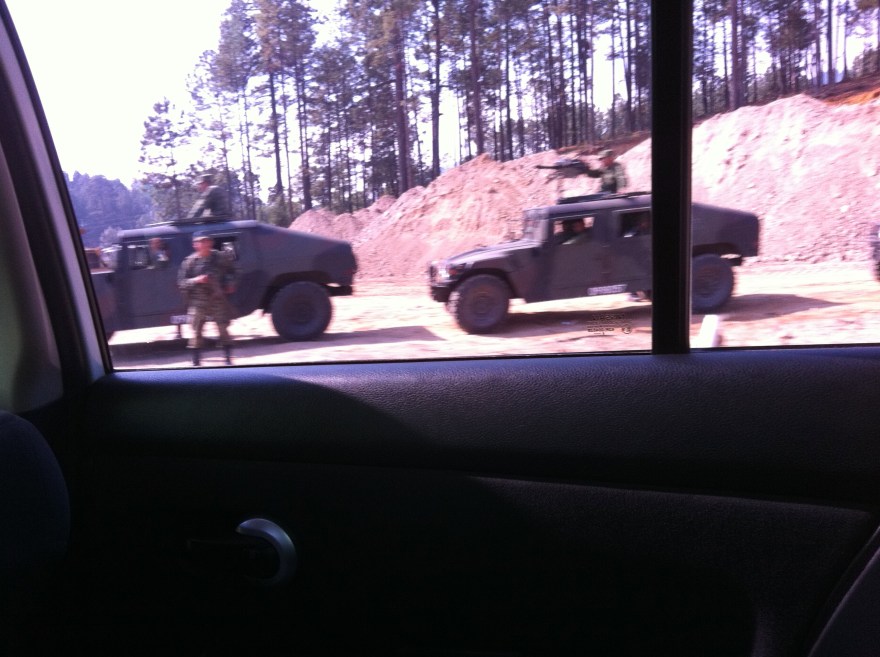
(Image 416) – The Zapatista rebels set up roadblocks along the roads in the state of Chiapas, Mexico. They want to secede and their interference with the government makes life interesting for locals and tourists alike. See my book The Crypt of the Ancients for an idea of what might happen if the rebels turned into kidnappers.
How does writing compare to the success you’ve had in the business world?
That depends on what one’s definition of success is. Financially my life in the corporate world buying and selling companies and making deals was vastly more successful. I think I’m just getting started in recognition as an author. It’s going well so far and I hope it’ll continue to provide more and more financial rewards.
The real measure of success for me is the satisfaction I receive in what I’m doing now. I absolutely love creating stories that other people will read and enjoy. It’s immensely gratifying when readers let me know they’re ready for the next book and loved the last one. The pleasure I receive from that makes it all incredibly rewarding.
Great definition of success. Love it.
What are you currently writing?
I recently finished The Outcasts, my tenth novel and the first I’ve written in the genre of apocalyptic disaster. This one is totally different for me and it’s a stand-alone book (at least so far – some readers are already asking for a sequel!) This book begins with a current theme – the election of 2016 when two candidates ran for president and most Americans weren’t that happy with either one of them. Two years later the House and Senate switch to the other party. In 2020 the Social Democrats are swept into power and they retain control of our government until the very last election ever in the United States – the presidential election of 2040. Things get really interesting after that!
The book I’m working on now is tentatively called The Black Cross. It’s another Brian Sadler mystery. Unlike Order of Succession, he plays a very prominent role in this one. It’s a story about voodoo, Christopher Columbus and an ancient relic; it’s set in New Orleans, Cuba and Guatemala. It will be released in late March 2017.
Wow. I love the premise of all your books. Can’t wait to read more.
Connect with Bill Thompson!
Goodreads | Website | Amazon


 Mystery Thriller Week